analyzing the discriminant\nwhich graph shows a quadratic function with a discriminant value of 0?
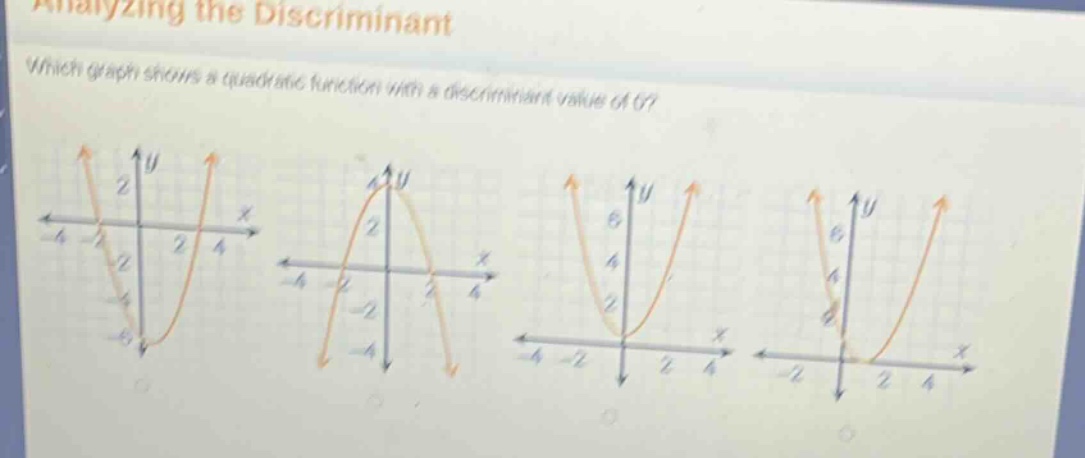
analyzing the discriminant\nwhich graph shows a quadratic function with a discriminant value of 0?
Answer
Explanation:
Step1: Recall discriminant - root relationship
For a quadratic function (y = ax^{2}+bx + c), the discriminant (\Delta=b^{2}-4ac). When (\Delta = 0), the quadratic - function has exactly one real root, which means the graph of the quadratic function touches the (x) - axis at exactly one point.
Step2: Analyze each graph
The first graph crosses the (x) - axis at two points, so (\Delta>0). The second graph also crosses the (x) - axis at two points, so (\Delta>0). The third graph touches the (x) - axis at exactly one point, so (\Delta = 0). The fourth graph does not cross or touch the (x) - axis, so (\Delta<0).
Answer:
The third graph (the one that touches the (x) - axis at exactly one point)