anderson uses the discriminant to correctly find the number of real solutions of the quadratic equation…
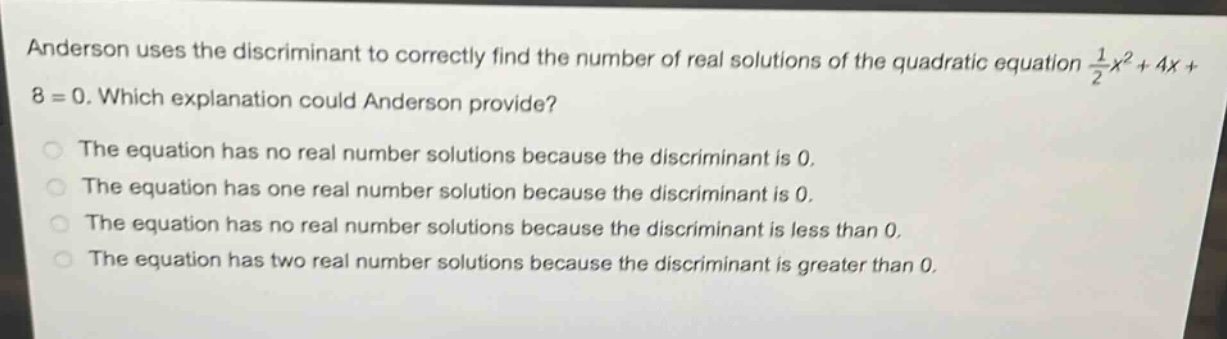
anderson uses the discriminant to correctly find the number of real solutions of the quadratic equation $\frac{1}{2}x^{2}+4x + 8 = 0$. which explanation could anderson provide?\nthe equation has no real number solutions because the discriminant is 0.\nthe equation has one real number solution because the discriminant is 0.\nthe equation has no real number solutions because the discriminant is less than 0.\nthe equation has two real number solutions because the discriminant is greater than 0.
Answer
Explanation:
Step1: Identify coefficients
For the quadratic equation $\frac{1}{2}x^{2}+4x + 8=0$, we have $a=\frac{1}{2}$, $b = 4$, $c = 8$.
Step2: Calculate the discriminant
The discriminant formula is $\Delta=b^{2}-4ac$. Substitute the values: $\Delta=(4)^{2}-4\times\frac{1}{2}\times8$. First, calculate $(4)^{2}=16$, and $4\times\frac{1}{2}\times8 = 16$. Then $\Delta=16 - 16=0$.
Step3: Determine the number of real - solutions
If $\Delta = 0$, the quadratic equation has one real number solution.
Answer:
The equation has one real number solution because the discriminant is 0.