the angle measures associated with which set of ordered pairs share the same reference angle?\n$\\left(-\\fra…
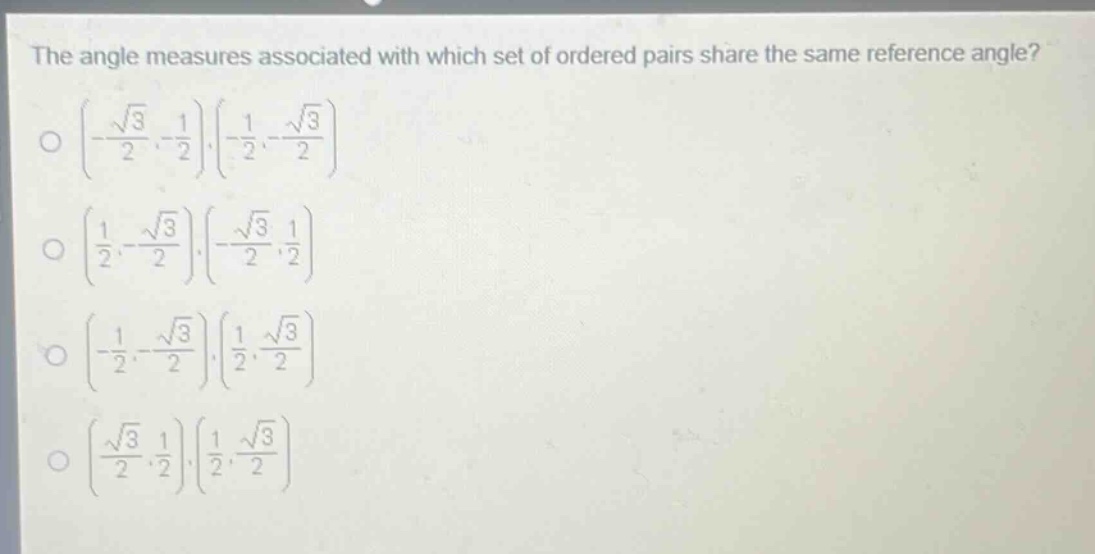
the angle measures associated with which set of ordered pairs share the same reference angle?\n$\\left(-\\frac{\\sqrt{3}}{2},-\\frac{1}{2}\\right),\\left(-\\frac{1}{2},-\\frac{\\sqrt{3}}{2}\\right)$\n$\\left(\\frac{1}{2},-\\frac{\\sqrt{3}}{2}\\right),\\left(-\\frac{\\sqrt{3}}{2},\\frac{1}{2}\\right)$\n$\\left(-\\frac{1}{2},-\\frac{\\sqrt{3}}{2}\\right),\\left(\\frac{1}{2},\\frac{\\sqrt{3}}{2}\\right)$\n$\\left(\\frac{\\sqrt{3}}{2},\\frac{1}{2}\\right),\\left(\\frac{1}{2},\\frac{\\sqrt{3}}{2}\\right)$
Answer
Answer:
C. $\left(-\frac{1}{2},-\frac{\sqrt{3}}{2}\right),\left(\frac{1}{2},\frac{\sqrt{3}}{2}\right)$
Explanation:
Step1: Recall the definition of reference - angle
The reference - angle is the acute angle formed between the terminal side of an angle in standard position and the x - axis. For a point $(x,y)$ on the unit circle $x = \cos\theta$ and $y=\sin\theta$.
Step2: Analyze the first option
For the points $\left(-\frac{\sqrt{3}}{2},-\frac{1}{2}\right)$ and $\left(-\frac{1}{2},-\frac{\sqrt{3}}{2}\right)$, the angles are in the third - quadrant. The reference angles are different.
Step3: Analyze the second option
For the points $\left(\frac{1}{2},-\frac{\sqrt{3}}{2}\right)$ and $\left(-\frac{\sqrt{3}}{2},\frac{1}{2}\right)$, one is in the fourth - quadrant and the other is in the second - quadrant. The reference angles are different.
Step4: Analyze the third option
For the point $\left(-\frac{1}{2},-\frac{\sqrt{3}}{2}\right)$, $\cos\theta=-\frac{1}{2}$ and $\sin\theta = -\frac{\sqrt{3}}{2}$, the angle $\theta = 240^{\circ}$ and its reference angle is $60^{\circ}$. For the point $\left(\frac{1}{2},\frac{\sqrt{3}}{2}\right)$, $\cos\theta=\frac{1}{2}$ and $\sin\theta=\frac{\sqrt{3}}{2}$, the angle $\theta = 60^{\circ}$. They have the same reference angle of $60^{\circ}$.
Step5: Analyze the fourth option
For the points $\left(\frac{\sqrt{3}}{2},\frac{1}{2}\right)$ and $\left(\frac{1}{2},\frac{\sqrt{3}}{2}\right)$, the angles are in the first - quadrant, but they are different non - reference angles.