an architecture firm is designing a pavilion in the shape of a square pyramid. they plan to add a string of…
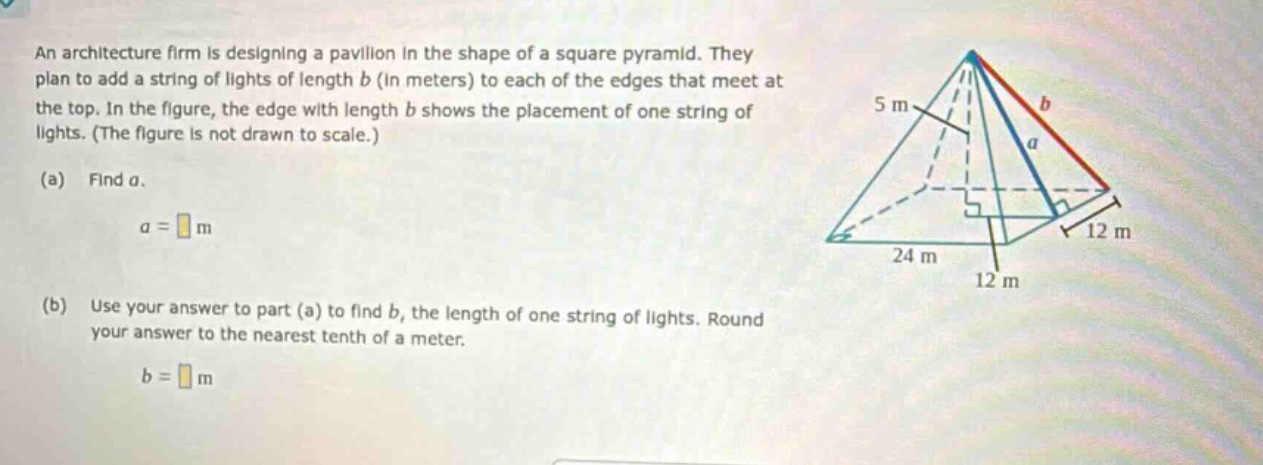
an architecture firm is designing a pavilion in the shape of a square pyramid. they plan to add a string of lights of length b (in meters) to each of the edges that meet at the top. in the figure, the edge with length b shows the placement of one string of lights. (the figure is not drawn to scale.) (a) find a. a = m (b) use your answer to part (a) to find b, the length of one string of lights. round your answer to the nearest tenth of a meter. b = m
Answer
Explanation:
Step1: Find the base - related length for part (a)
The base is a square with side - length 24 m. The distance from the center of the square base to a side is half of the side - length of the square base. So, the base of the right - triangle for finding (a) is 12 m.
Step2: Calculate (a) using the Pythagorean theorem
In the right - triangle with height 5 m and base 12 m, by the Pythagorean theorem (a=\sqrt{5^{2}+12^{2}}). [a=\sqrt{25 + 144}=\sqrt{169}=13]
Step3: Calculate (b) using the Pythagorean theorem for part (b)
We know the base of the right - triangle for finding (b) is 12 m and the other leg is (a = 13) m. By the Pythagorean theorem (b=\sqrt{13^{2}+12^{2}}). [b=\sqrt{169+144}=\sqrt{313}\approx17.7]
Answer:
(a) (a = 13) m (b) (b\approx17.7) m