the axis of symmetry for a quadratic equation can be found using the formula $x = \\frac{-b}{2a}$, where a…
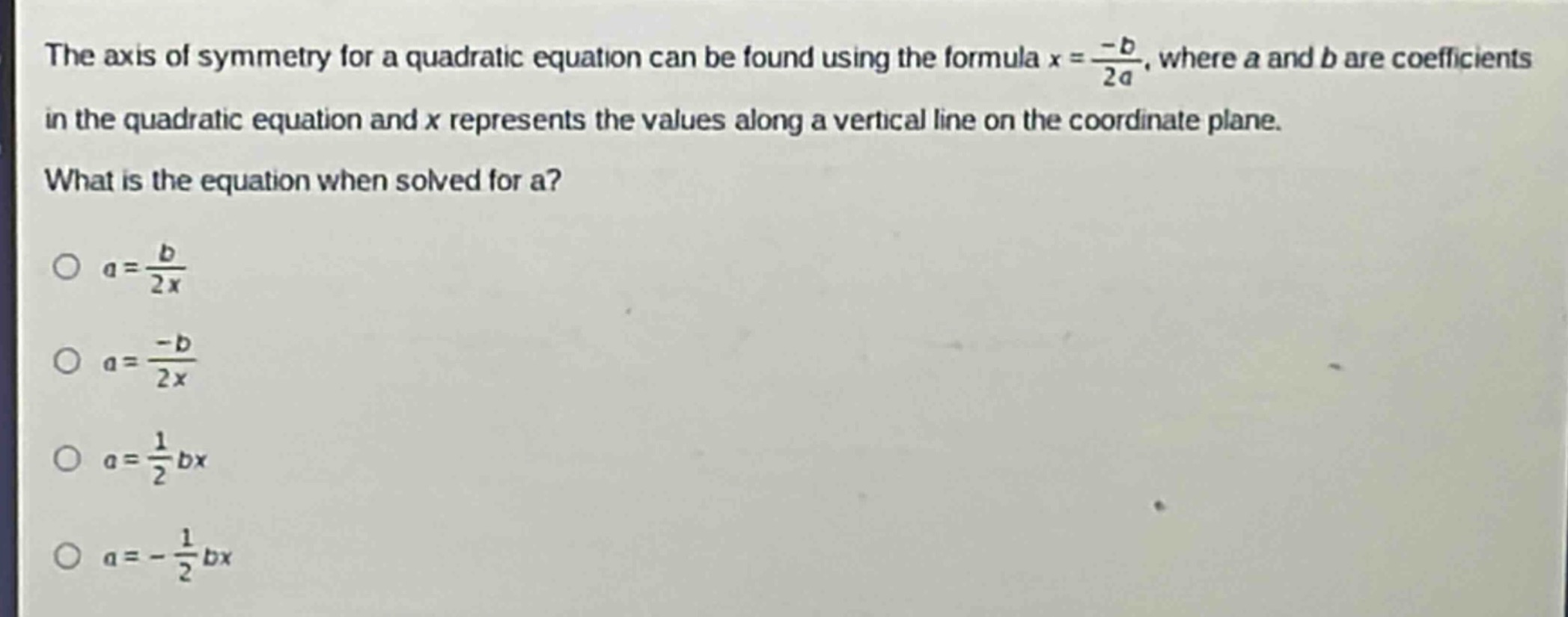
the axis of symmetry for a quadratic equation can be found using the formula $x = \\frac{-b}{2a}$, where a and b are coefficients in the quadratic equation and x represents the values along a vertical line on the coordinate plane. what is the equation when solved for a?\n$a = \\frac{b}{2x}$\n$a = \\frac{-b}{2x}$\n$a = \\frac{1}{2}bx$\n$a = -\\frac{1}{2}bx$
Answer
Explanation:
Step1: Cross - multiply the equation
Given $x=\frac{-b}{2a}$, cross - multiplying gives $2ax=-b$.
Step2: Solve for a
Divide both sides of the equation $2ax = - b$ by $2x$ (assuming $x\neq0$), we get $a=\frac{-b}{2x}$.
Answer:
$a=\frac{-b}{2x}$