a baker makes apple tarts and apple pies each day. each tart, t, requires 1 apple, and each pie, p, requires…
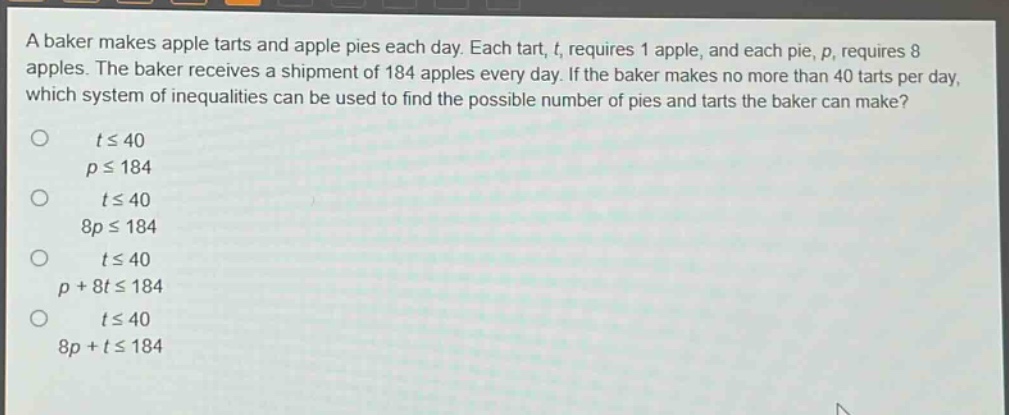
a baker makes apple tarts and apple pies each day. each tart, t, requires 1 apple, and each pie, p, requires 8 apples. the baker receives a shipment of 184 apples every day. if the baker makes no more than 40 tarts per day, which system of inequalities can be used to find the possible number of pies and tarts the baker can make?\no t ≤ 40\np ≤ 184\no t ≤ 40\n8p ≤ 184\no t ≤ 40\np + 8t ≤ 184\no t ≤ 40\n8p + t ≤ 184
Answer
Explanation:
Step1: Analizar la cantidad máxima de tartas
El panadero no hace más de 40 tartas al día, por lo que $t\leq40$.
Step2: Analizar el uso de manzanas
Cada tarta $t$ requiere 1 manzana y cada pastel $p$ requiere 8 manzanas, y el panadero recibe 184 manzanas al día. Entonces la cantidad total de manzanas utilizadas en tartas y pasteles no puede superar 184, es decir $8p + t\leq184$.
Answer:
$t\leq40$ $8p + t\leq184$