a ball is thrown straight up from a height of 3 ft with a speed of 32 ft/s. its height above the ground…
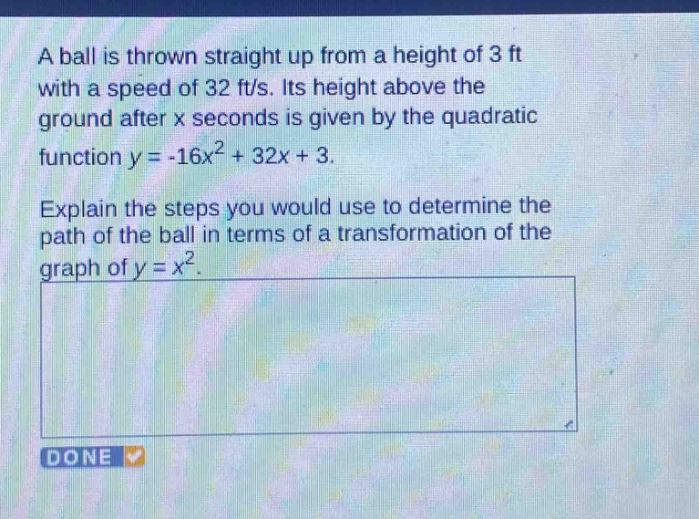
a ball is thrown straight up from a height of 3 ft with a speed of 32 ft/s. its height above the ground after x seconds is given by the quadratic function y = -16x² + 32x + 3. explain the steps you would use to determine the path of the ball in terms of a transformation of the graph of y = x².
Answer
Explanation:
Step1: Factor out -16 from first two terms
$y=-16(x^{2} - 2x)+3$
Step2: Complete the square inside the parentheses
$y=-16(x^{2}-2x + 1-1)+3$
Step3: Rewrite the expression
$y=-16((x - 1)^{2}-1)+3$
Step4: Distribute -16
$y=-16(x - 1)^{2}+16 + 3$
Step5: Simplify
$y=-16(x - 1)^{2}+19$
Starting from $y = x^{2}$:
- First, there is a vertical stretch by a factor of 16 and a reflection across the x - axis due to the coefficient -16 in front of the squared term.
- Then, there is a horizontal shift 1 unit to the right because of $(x - 1)^{2}$.
- Finally, there is a vertical shift 19 units up.
Answer:
Starting from $y = x^{2}$, we vertically stretch by a factor of 16 and reflect across the x - axis, then shift 1 unit to the right horizontally and 19 units up vertically to get the graph of $y=-16x^{2}+32x + 3$.