the base of a solid oblique pyramid is an equilateral triangle with a base edge length of 14 units. what is…
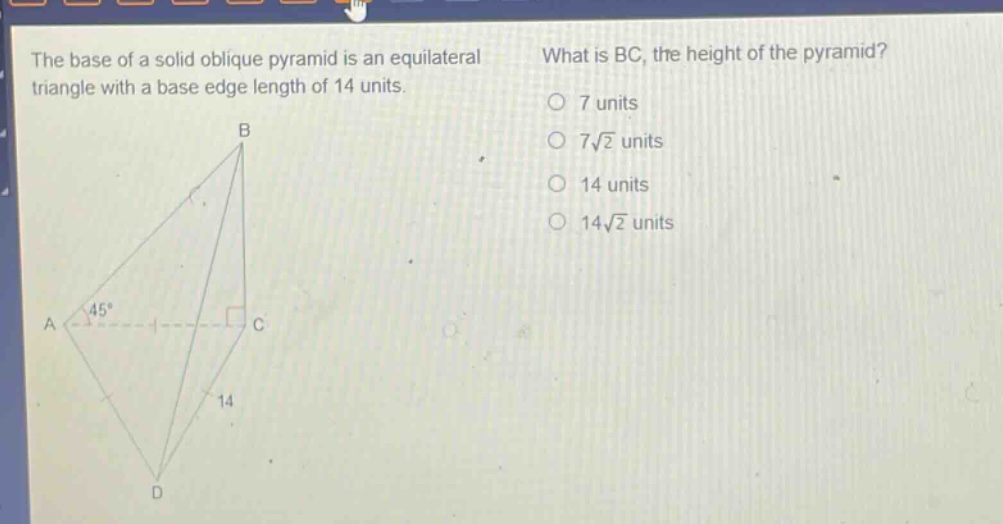
the base of a solid oblique pyramid is an equilateral triangle with a base edge length of 14 units. what is bc, the height of the pyramid? 7 units 7√2 units 14 units 14√2 units
Answer
Explanation:
Step1: Find the distance from the center of the base to a vertex
For an equilateral - triangle base with side length (a = 14) units, the distance from the center of the equilateral triangle to a vertex can be found using the formula for the circum - radius of an equilateral triangle (R=\frac{a}{\sqrt{3}}). In a right - triangle formed by the height of the pyramid ((BC)), the line from the center of the base to a vertex ((AC)), and the slant height ((AB)), we can also use the fact that in right - triangle (ABC), (\angle BAC = 45^{\circ}). First, find the distance from the center of the equilateral triangle base to a vertex. The centroid of an equilateral triangle divides the median in the ratio (2:1) from the vertex. The length of the median of an equilateral triangle with side length (a) is (m=\frac{\sqrt{3}}{2}a). The distance from the center of the equilateral triangle to a vertex (AC) is (\frac{2}{3}\times\frac{\sqrt{3}}{2}a=\frac{\sqrt{3}}{3}a). Substituting (a = 14), we get (AC=\frac{14}{\sqrt{3}}) units. But we can also use the right - triangle (ABC) directly.
Step2: Use the right - triangle relationship
In right - triangle (ABC), (\angle BAC = 45^{\circ}) and (\angle BCA=90^{\circ}), so (\triangle ABC) is a (45 - 45-90) right - triangle. In a (45 - 45-90) right - triangle, if the length of the non - hypotenuse side (adjacent to the (45^{\circ}) angle) is (x), and the length of the other non - hypotenuse side (opposite to the (45^{\circ}) angle) is (y), then (x = y). Here, assume (AC) is the adjacent side and (BC) is the opposite side to the (45^{\circ}) angle. Also, we can consider the right - triangle formed by the height of the pyramid and half of the side of the equilateral base. The side of the equilateral base is (a = 14) units. Let's consider the right - triangle (ABC) where the slant height (AB) and the base distance (AC) and height (BC) are related. Since (\angle BAC = 45^{\circ}) and (\angle BCA = 90^{\circ}), and we know that (\tan45^{\circ}=1=\frac{BC}{AC}). In right - triangle (ABC), if we consider the fact that the base is an equilateral triangle and we know the side length of the base is (14) units. The distance from the center of the equilateral base to a vertex is not needed. We know that in right - triangle (ABC) with (\angle BAC = 45^{\circ}) and (\angle BCA = 90^{\circ}), and the slant height (AB = 14) units. Using the sine or cosine of the (45^{\circ}) angle in right - triangle (ABC). Since (\sin45^{\circ}=\frac{BC}{AB}) and (AB = 14) units. We know that (\sin45^{\circ}=\frac{\sqrt{2}}{2}), so (BC = AB\sin45^{\circ}). Substituting (AB = 14) into the formula (BC=14\times\frac{\sqrt{2}}{2}=7\sqrt{2}) units.
Answer:
7(\sqrt{2}) units