which best explains if quadrilateral wxyz can be a parallelogram? wxyz can be a parallelogram with one pair…
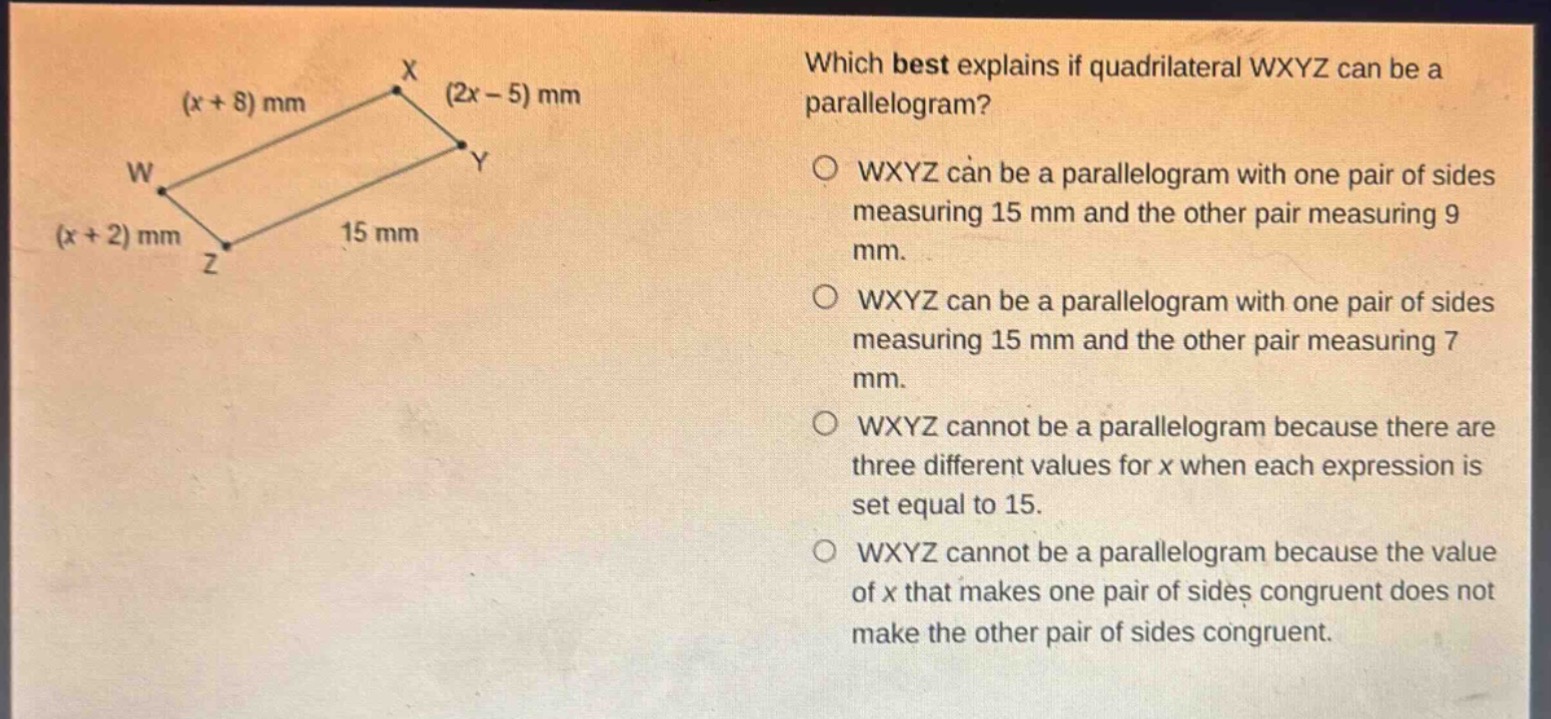
which best explains if quadrilateral wxyz can be a parallelogram? wxyz can be a parallelogram with one pair of sides measuring 15 mm and the other pair measuring 9 mm. wxyz can be a parallelogram with one pair of sides measuring 15 mm and the other pair measuring 7 mm. wxyz cannot be a parallelogram because there are three different values for x when each expression is set equal to 15. wxyz cannot be a parallelogram because the value of x that makes one pair of sides congruent does not make the other pair of sides congruent.
Answer
Explanation:
Step1: Recall parallelogram property
In a parallelogram, opposite - sides are equal. So we set up two equations: (x + 8=15) and (x + 2=2x - 5).
Step2: Solve (x + 8=15)
Subtract 8 from both sides: (x=15 - 8=7).
Step3: Solve (x + 2=2x - 5)
First, move the (x) terms to one side: (2x-x=2 + 5), so (x = 7). But if we consider the other pair of opposite - sides, if (x+8 = 15) (so (x = 7)), then (x + 2=7 + 2=9) and (2x-5=2\times7-5=14 - 5 = 9). However, if we set (x + 2=15), then (x = 13), and (x + 8=13 + 8=21) and (2x-5=2\times13-5=26 - 5 = 21). The value of (x) that makes one pair of sides congruent does not make the other pair of sides congruent.
Answer:
WXYZ cannot be a parallelogram because the value of (x) that makes one pair of sides congruent does not make the other pair of sides congruent.