what is the binomial expansion of (2x - 3)^5?\n(2x)^5 - 15(2x)^4 + 90(2x)^3 - 270(2x)^2 + 405(2x)…
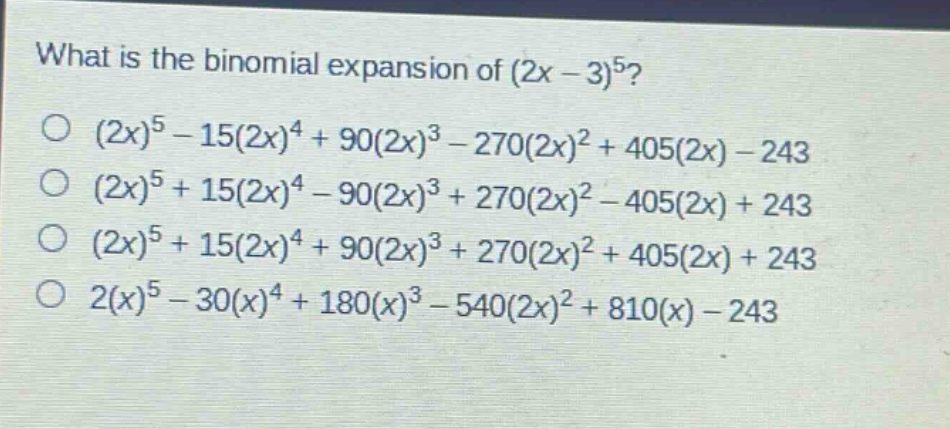
what is the binomial expansion of (2x - 3)^5?\n(2x)^5 - 15(2x)^4 + 90(2x)^3 - 270(2x)^2 + 405(2x) - 243\n(2x)^5 + 15(2x)^4 - 90(2x)^3 + 270(2x)^2 - 405(2x) + 243\n(2x)^5 + 15(2x)^4 + 90(2x)^3 + 270(2x)^2 + 405(2x) + 243\n2(x)^5 - 30(x)^4 + 180(x)^3 - 540(2x)^2 + 810(x) - 243
Answer
Explanation:
Step1: Recall binomial theorem
The binomial theorem states that $(a + b)^n=\sum_{k = 0}^{n}\binom{n}{k}a^{n - k}b^{k}$. For $(2x-3)^5$, where $a = 2x$, $b=- 3$ and $n = 5$.
Step2: Calculate each term
The binomial coefficients $\binom{5}{k}=\frac{5!}{k!(5 - k)!}$.
- When $k = 0$: $\binom{5}{0}(2x)^{5}(-3)^{0}=(2x)^{5}$
- When $k = 1$: $\binom{5}{1}(2x)^{4}(-3)^{1}=5\times16x^{4}\times(-3)=- 15(2x)^{4}$
- When $k = 2$: $\binom{5}{2}(2x)^{3}(-3)^{2}=\frac{5!}{2!(5 - 2)!}\times8x^{3}\times9 = 10\times8x^{3}\times9=90(2x)^{3}$
- When $k = 3$: $\binom{5}{3}(2x)^{2}(-3)^{3}=\frac{5!}{3!(5 - 3)!}\times4x^{2}\times(-27)=10\times4x^{2}\times(-27)=-270(2x)^{2}$
- When $k = 4$: $\binom{5}{4}(2x)^{1}(-3)^{4}=5\times2x\times81 = 405(2x)$
- When $k = 5$: $\binom{5}{5}(2x)^{0}(-3)^{5}=-243$
Step3: Combine the terms
$(2x - 3)^5=(2x)^{5}-15(2x)^{4}+90(2x)^{3}-270(2x)^{2}+405(2x)-243$
Answer:
$(2x)^{5}-15(2x)^{4}+90(2x)^{3}-270(2x)^{2}+405(2x)-243$