how could brent use a rectangle to model the factors of x² - 7x + 6? he could draw a diagram of a rectangle…
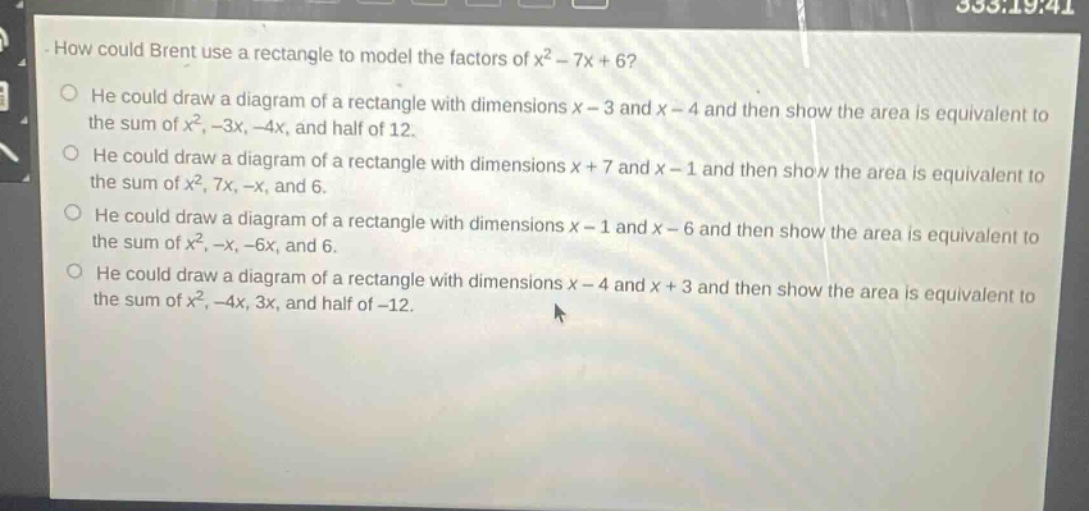
how could brent use a rectangle to model the factors of x² - 7x + 6? he could draw a diagram of a rectangle with dimensions x - 3 and x - 4 and then show the area is equivalent to the sum of x², -3x, -4x, and half of 12. he could draw a diagram of a rectangle with dimensions x + 7 and x - 1 and then show the area is equivalent to the sum of x², 7x, -x, and 6. he could draw a diagram of a rectangle with dimensions x - 1 and x - 6 and then show the area is equivalent to the sum of x², -x, -6x, and 6. he could draw a diagram of a rectangle with dimensions x - 4 and x + 3 and then show the area is equivalent to the sum of x², -4x, 3x, and half of -12.
Answer
Explanation:
Step1: Expand each option
For a rectangle with length $l$ and width $w$, the area $A = l\times w$.
- Option 1: $(x - 3)(x - 4)=x^{2}-4x-3x + 12=x^{2}-7x + 12\neq x^{2}-7x + 6$.
- Option 2: $(x + 7)(x - 1)=x^{2}-x+7x-7=x^{2}+6x-7\neq x^{2}-7x + 6$.
- Option 3: $(x - 1)(x - 6)=x^{2}-6x-x + 6=x^{2}-7x + 6$.
- Option 4: $(x - 4)(x + 3)=x^{2}+3x-4x-12=x^{2}-x-12\neq x^{2}-7x + 6$.
Answer:
He could draw a diagram of a rectangle with dimensions $x - 1$ and $x - 6$ and then show the area is equivalent to the sum of $x^{2},-x,-6x$, and $6$.