a bungee jumper falls 97.2 feet before bouncing back up at the end of his bungee cord. then he falls 64.8…
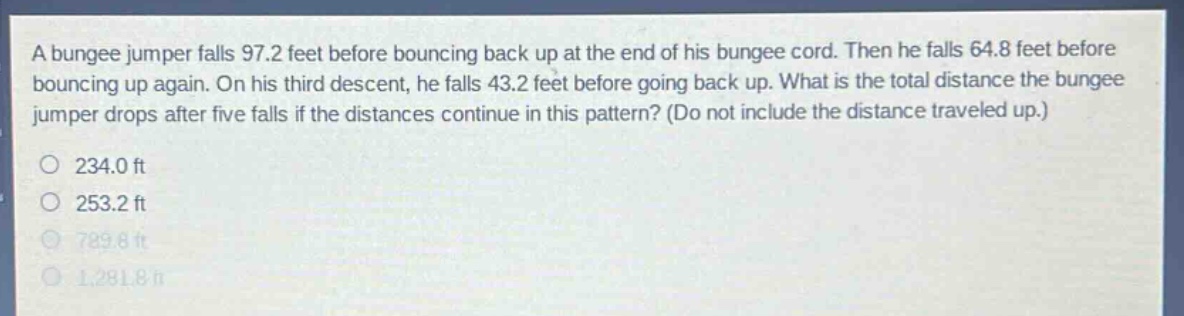
a bungee jumper falls 97.2 feet before bouncing back up at the end of his bungee cord. then he falls 64.8 feet before bouncing up again. on his third descent, he falls 43.2 feet before going back up. what is the total distance the bungee jumper drops after five falls if the distances continue in this pattern? (do not include the distance traveled up.)\n234.0 ft\n253.2 ft\n789.8 ft\n1,281.8 ft
Answer
Explanation:
Step1: Identify the sequence type
This is a geometric - sequence with first term (a = 97.2) and common ratio (r=\frac{64.8}{97.2}=\frac{2}{3}).
Step2: Use the sum formula for a geometric series
The sum formula for the first (n) terms of a geometric series is (S_n=\frac{a(1 - r^n)}{1 - r}), where (a) is the first term, (r) is the common ratio, and (n) is the number of terms. Here, (a = 97.2), (r=\frac{2}{3}), and (n = 5). [ \begin{align*} S_5&=\frac{97.2\times\left(1-\left(\frac{2}{3}\right)^5\right)}{1-\frac{2}{3}}\ &=\frac{97.2\times\left(1-\frac{32}{243}\right)}{\frac{1}{3}}\ &=97.2\times3\times\left(1 - \frac{32}{243}\right)\ &=291.6\times\frac{243 - 32}{243}\ &=291.6\times\frac{211}{243}\ &=\frac{291.6\times211}{243}\ &=\frac{61527.6}{243}\ & = 253.2 \end{align*} ]
Answer:
253.2 ft