1. carpet for a recreation room costs $8.50 per square metre. the room measures 20 ft by 15 ft. how much…
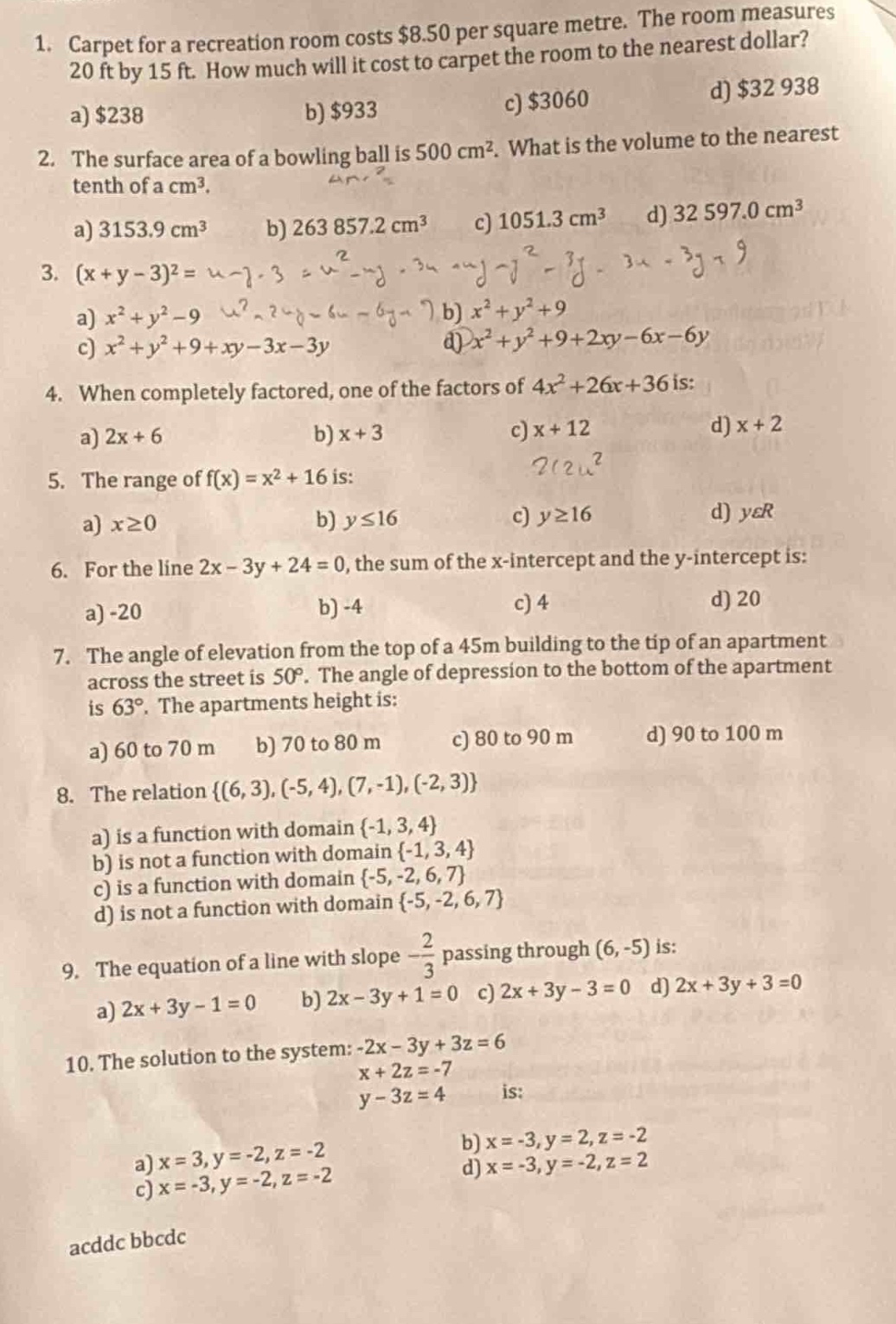
1. carpet for a recreation room costs $8.50 per square metre. the room measures 20 ft by 15 ft. how much will it cost to carpet the room to the nearest dollar? a) $238 b) $933 c) $3060 d) $32938\n2. the surface area of a bowling ball is 500 cm². what is the volume to the nearest tenth of a cm³. a) 3153.9 cm³ b) 263857.2 cm³ c) 1051.3 cm³ d) 32597.0 cm³\n3. (x + y - 3)²= a) x² + y² - 9 b) x² + y² + 9 c) x² + y² + 9+xy - 3x - 3y d) x² + y² + 9+2xy - 6x - 6y\n4. when completely factored, one of the factors of 4x² + 26x + 36 is: a) 2x + 6 b) x + 3 c) x + 12 d) x + 2\n5. the range of f(x)=x² + 16 is: a) x≥0 b) y≤16 c) y≥16 d) y∈r\n6. for the line 2x - 3y + 24 = 0, the sum of the x - intercept and the y - intercept is: a) - 20 b) - 4 c) 4 d) 20\n7. the angle of elevation from the top of a 45m building to the tip of an apartment across the street is 50°. the angle of depression to the bottom of the apartment is 63°. the apartments height is: a) 60 to 70 m b) 70 to 80 m c) 80 to 90 m d) 90 to 100 m\n8. the relation {(6,3),(-5,4),(7, - 1),(-2,3)} a) is a function with domain {-1,3,4} b) is not a function with domain {-1,3,4} c) is a function with domain {-5,-2,6,7} d) is not a function with domain {-5,-2,6,7}\n9. the equation of a line with slope - 2/3 passing through (6, - 5) is: a) 2x + 3y - 1 = 0 b) 2x - 3y + 1 = 0 c) 2x + 3y - 3 = 0 d) 2x + 3y + 3 = 0\n10. the solution to the system: - 2x - 3y + 3z = 6, x + 2z=-7, y - 3z = 4 is: a) x = 3,y=-2,z=-2 b) x=-3,y = 2,z=-2 c) x=-3,y=-2,z=-2 d) x=-3,y=-2,z = 2\nacddc bbcdc
Answer
Explanation:
Step1: Convert room dimensions to metres
1 foot = 0.3048 metres. So, 20 ft = 20×0.3048 = 6.096 m and 15 ft = 15×0.3048 = 4.572 m.
Step2: Calculate room area
Area of rectangle = length×width. So area A = 6.096×4.572 $\approx$ 27.87 m².
Step3: Calculate cost
Cost = rate×area. Cost = 8.50×27.87 $\approx$ 237.8 = 238 (rounded to nearest dollar).
Answer:
a) $238
Explanation:
Step1: Find radius from surface - area formula
The surface - area formula of a sphere is $A = 4\pi r^{2}$. Given $A = 500$ cm², then $r^{2}=\frac{A}{4\pi}=\frac{500}{4\pi}$, and $r=\sqrt{\frac{500}{4\pi}}\approx\sqrt{\frac{500}{4\times3.14}}\approx\sqrt{39.81}\approx 6.31$ cm.
Step2: Calculate volume
The volume formula of a sphere is $V=\frac{4}{3}\pi r^{3}$. Substitute $r\approx6.31$ cm into the formula: $V=\frac{4}{3}\pi(6.31)^{3}\approx\frac{4}{3}\times3.14\times250.04\approx1051.3$ cm³.
Answer:
c) $1051.3$ cm³
Explanation:
Step1: Expand using formula $(a + b + c)^{2}=a^{2}+b^{2}+c^{2}+2ab + 2ac+2bc$
Here $a = x$, $b = y$, $c=-3$. So $(x + y-3)^{2}=x^{2}+y^{2}+(-3)^{2}+2xy+2x(-3)+2y(-3)=x^{2}+y^{2}+9 + 2xy-6x - 6y$.
Answer:
d) $x^{2}+y^{2}+9 + 2xy-6x - 6y$
Explanation:
Step1: Factor out the greatest - common factor
First, factor out 2 from $4x^{2}+26x + 36$ to get $2(2x^{2}+13x + 18)$. Then factor $2x^{2}+13x + 18$: $2x^{2}+13x + 18=2x^{2}+4x+9x + 18=2x(x + 2)+9(x + 2)=(2x + 9)(x + 2)$. The original expression $4x^{2}+26x + 36=2(2x + 9)(x + 2)$. One of the factors is $x + 2$.
Answer:
d) $x + 2$
Explanation:
Step1: Analyze the function $y=x^{2}+16$
Since $x^{2}\geq0$ for all real $x$, then $y=x^{2}+16\geq16$.
Answer:
c) $y\geq16$
Explanation:
Step1: Find x - intercept
Set $y = 0$ in $2x-3y + 24=0$. Then $2x+24=0$, so $x=-12$.
Step2: Find y - intercept
Set $x = 0$ in $2x-3y + 24=0$. Then $-3y+24=0$, so $y = 8$.
Step3: Calculate the sum
Sum of x - intercept and y - intercept is $-12 + 8=-4$.
Answer:
b) - 4
Explanation:
Step1: Let the distance between the buildings be $d$
We know that $\tan63^{\circ}=\frac{45}{d}$, so $d=\frac{45}{\tan63^{\circ}}\approx\frac{45}{1.9626}\approx23$ m.
Step2: Let the height above the 45 - m building be $h$
We know that $\tan50^{\circ}=\frac{h}{d}$, and since $d\approx23$ m, then $h = d\tan50^{\circ}\approx23\times1.1918\approx27.4$ m.
Step3: Calculate the height of the apartment building
The height of the apartment building is $45 + h\approx45+27.4 = 72.4$ m, which is in the range 70 to 80 m.
Answer:
b) 70 to 80 m
Explanation:
Step1: Check if it's a function
A relation is a function if each input (x - value) has exactly one output (y - value). In the relation ${(6,3),(-5,4),(7,-1),(-2,3)}$, each x - value ($-5,-2,6,7$) has a unique y - value. The domain is the set of all x - values, which is ${-5,-2,6,7}$.
Answer:
c) is a function with domain ${-5,-2,6,7}$
Explanation:
Step1: Use point - slope form $y - y_{1}=m(x - x_{1})$
Given $m=-\frac{2}{3}$, $x_{1}=6$, $y_{1}=-5$. Then $y+5=-\frac{2}{3}(x - 6)$.
Step2: Rearrange to general form
$y+5=-\frac{2}{3}x + 4$, multiply through by 3 to get $3y+15=-2x + 12$, and then $2x+3y+3 = 0$.
Answer:
d) $2x + 3y+3 = 0$
Explanation:
Step1: From $x + 2z=-7$, we have $x=-7 - 2z$
From $y-3z = 4$, we have $y=4 + 3z$.
Step2: Substitute into the first equation
Substitute $x=-7 - 2z$ and $y=4 + 3z$ into $-2x-3y + 3z=6$. $-2(-7 - 2z)-3(4 + 3z)+3z=6$. $14 + 4z-12-9z + 3z=6$. $2-2z=6$, $-2z=4$, $z=-2$.
Step3: Find $x$ and $y$
If $z=-2$, then $x=-7-2(-2)=-7 + 4=-3$ and $y=4+3(-2)=4 - 6=-2$.
Answer:
c) $x=-3,y=-2,z=-2$