casey is deciding which of two landscapers to hire. each landscaper charges an hourly rate plus a fee for…
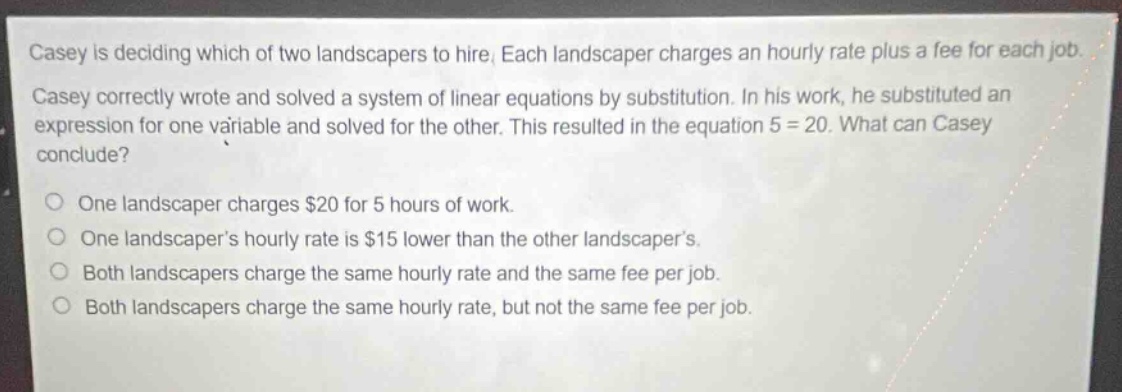
casey is deciding which of two landscapers to hire. each landscaper charges an hourly rate plus a fee for each job. casey correctly wrote and solved a system of linear equations by substitution. in his work, he substituted an expression for one variable and solved for the other. this resulted in the equation 5 = 20. what can casey conclude? one landscaper charges $20 for 5 hours of work. one landscapers hourly rate is $15 lower than the other landscapers. both landscapers charge the same hourly rate and the same fee per job. both landscapers charge the same hourly rate, but not the same fee per job.
Answer
Explanation:
Step1: Analyze equation result
The equation 5 = 20 is a false - statement. In the context of solving a system of linear equations, when we get a false - statement like this after substitution, it means the system of equations has no solution.
Step2: Relate to landscaper costs
Let the cost equations for the two landscapers be (C_1 = r_1h + f_1) and (C_2=r_2h + f_2), where (r) is the hourly rate and (f) is the fee per job. A no - solution system implies that the two lines (cost functions) are parallel. For two lines (y = mx + b) (in our case, cost as a function of hours), parallel lines have the same slope ((m)). Here, the slope is the hourly rate. Since the lines are parallel and not the same line (because the system has no solution), the hourly rates ((r_1=r_2)) are the same, but the y - intercepts (the fee per job (f_1\neq f_2)).
Answer:
Both landscapers charge the same hourly rate, but not the same fee per job.