catalyst take part in a reaction. *\n10 points\ntrue\nfalse\n\norganic compounds contain the element…
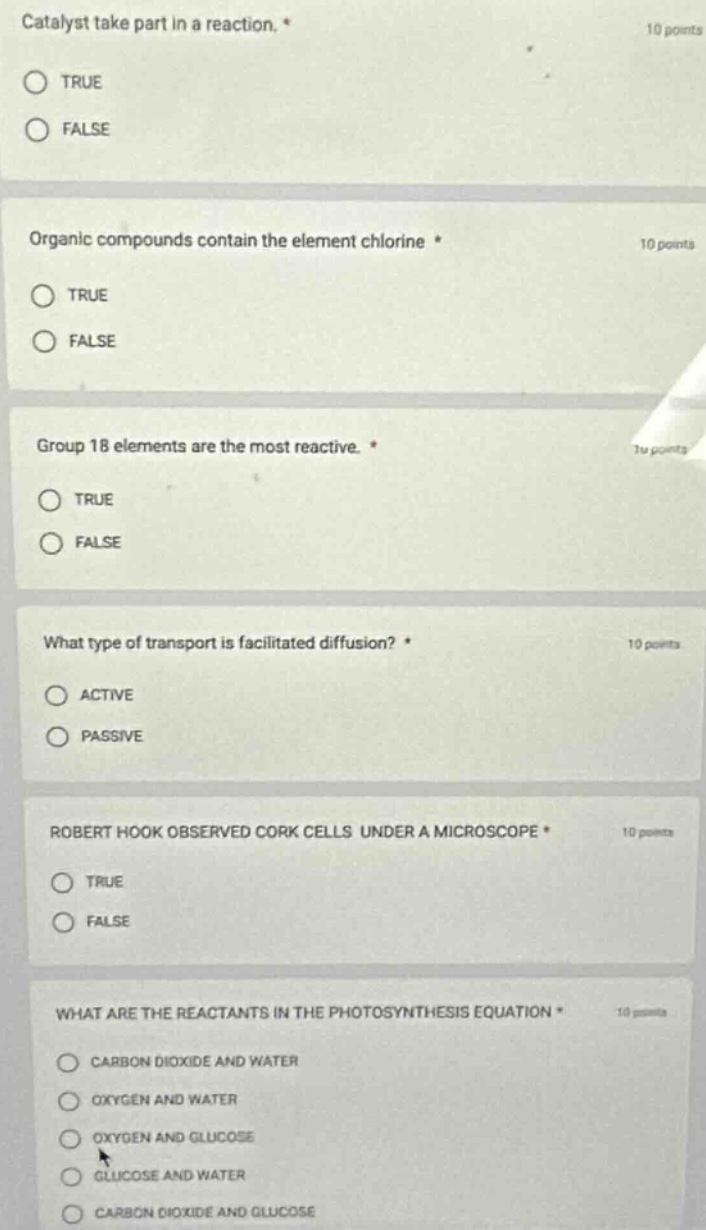
catalyst take part in a reaction. *\n10 points\ntrue\nfalse\n\norganic compounds contain the element chlorine *\n10 points\ntrue\nfalse\n\ngroup 18 elements are the most reactive. *\n10 points\ntrue\nfalse\n\nwhat type of transport is facilitated diffusion? *\n10 points\nactive\npassive\n\nrobert hook observed cork cells under a microscope *\n10 points\ntrue\nfalse\n\nwhat are the reactants in the photosynthesis equation *\n10 points\ncarbon dioxide and water\noxygen and water\noxygen and glucose\nglucose and water\ncarbon dioxide and glucose
Answer
Brief Explanations:
- Catalysts lower the activation - energy of a reaction by participating in it temporarily and then being regenerated, so "Catalyst take part in a reaction" is TRUE.
- Organic compounds are defined as compounds containing carbon (usually with hydrogen), not chlorine, so "Organic compounds contain the element chlorine" is FALSE.
- Group 18 elements are noble gases and are very unreactive due to their full - valence electron shells, so "Group 18 elements are the most reactive" is FALSE.
- Facilitated diffusion is a type of passive transport as it does not require energy input and moves substances down their concentration gradient with the help of transport proteins, so the answer is PASSIVE.
- Robert Hooke was the first to observe cork cells under a microscope and coin the term "cell", so "ROBERT HOOK OBSERVED CORK CELLS UNDER A MICROSCOPE" is TRUE.
- The reactants in the photosynthesis equation are carbon dioxide and water, which are converted into oxygen and glucose using light energy, so the answer is CARBON DIOXIDE AND WATER.
Answer:
- TRUE
- FALSE
- FALSE
- PASSIVE
- TRUE
- CARBON DIOXIDE AND WATER