choose all the functions that have complex solutions.\na. $f(x)=x^{2}-8x + 25$\nb. $h(x)=x^{2}+8x + 25$\nc…
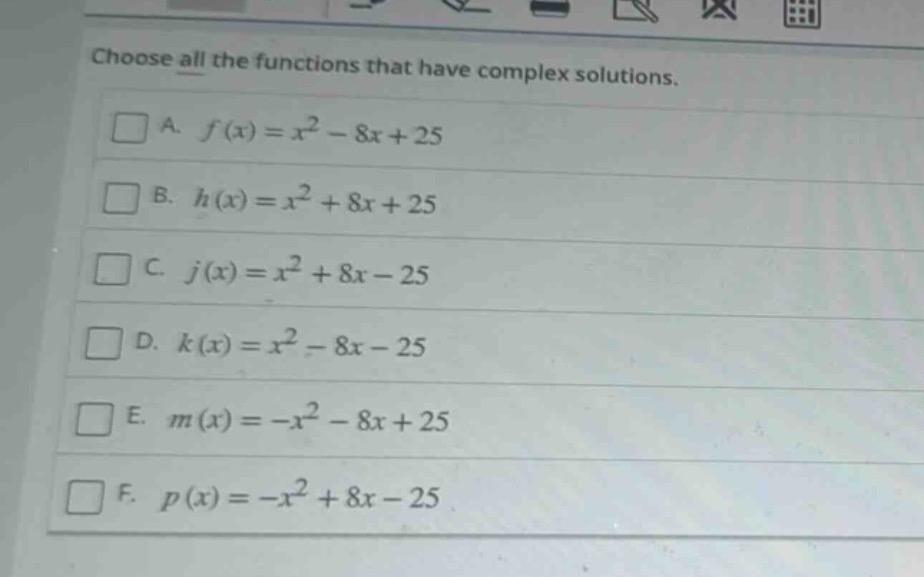
choose all the functions that have complex solutions.\na. $f(x)=x^{2}-8x + 25$\nb. $h(x)=x^{2}+8x + 25$\nc. $j(x)=x^{2}+8x - 25$\nd. $k(x)=x^{2}-8x - 25$\ne. $m(x)=-x^{2}-8x + 25$\nf. $p(x)=-x^{2}+8x - 25$
Answer
Explanation:
Step1: Recall the discriminant formula
For a quadratic function $y = ax^{2}+bx + c$, the discriminant is $\Delta=b^{2}-4ac$. If $\Delta<0$, the function has complex - valued solutions.
Step2: Analyze function A
For $f(x)=x^{2}-8x + 25$, where $a = 1$, $b=-8$, and $c = 25$. Then $\Delta=(-8)^{2}-4\times1\times25=64 - 100=-36<0$.
Step3: Analyze function B
For $h(x)=x^{2}+8x + 25$, where $a = 1$, $b = 8$, and $c = 25$. Then $\Delta=8^{2}-4\times1\times25=64 - 100=-36<0$.
Step4: Analyze function C
For $j(x)=x^{2}+8x-25$, where $a = 1$, $b = 8$, and $c=-25$. Then $\Delta=8^{2}-4\times1\times(-25)=64 + 100 = 164>0$.
Step5: Analyze function D
For $k(x)=x^{2}-8x-25$, where $a = 1$, $b=-8$, and $c=-25$. Then $\Delta=(-8)^{2}-4\times1\times(-25)=64 + 100 = 164>0$.
Step6: Analyze function E
For $m(x)=-x^{2}-8x + 25$, where $a=-1$, $b=-8$, and $c = 25$. Then $\Delta=(-8)^{2}-4\times(-1)\times25=64 + 100 = 164>0$.
Step7: Analyze function F
For $p(x)=-x^{2}+8x-25$, where $a=-1$, $b = 8$, and $c=-25$. Then $\Delta=8^{2}-4\times(-1)\times(-25)=64 - 100=-36<0$.
Answer:
A. $f(x)=x^{2}-8x + 25$, B. $h(x)=x^{2}+8x + 25$, F. $p(x)=-x^{2}+8x-25$