choose the graph of y < -x² + 4x + 5.
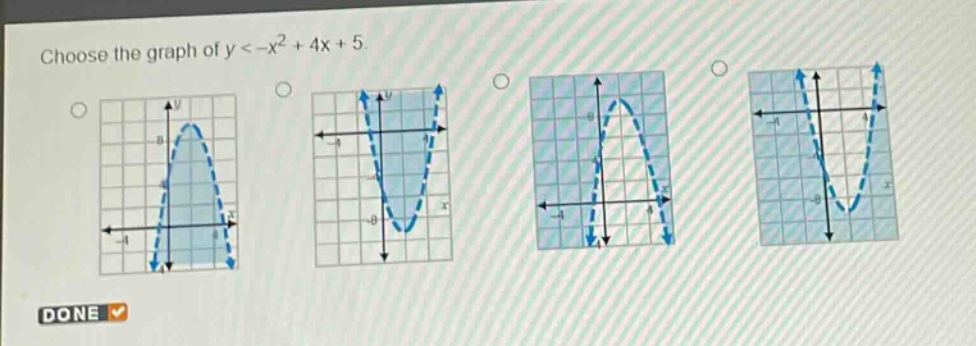
choose the graph of y < -x² + 4x + 5.
Answer
Answer:
The graph of the parabola (y = -x^{2}+4x + 5) is a downward - opening parabola (since the coefficient of (x^{2}) is negative, (a=-1<0)). First, find the vertex of the parabola. The (x) - coordinate of the vertex of a parabola (y = ax^{2}+bx + c) is given by (x=-\frac{b}{2a}). Here, (a=-1), (b = 4), so (x=-\frac{4}{2\times(-1)} = 2). Substitute (x = 2) into the equation (y=-x^{2}+4x + 5): (y=-(2)^{2}+4\times2 + 5=-4 + 8+5=9). So the vertex is ((2,9)).
To find the (x) - intercepts, set (y = 0): (-x^{2}+4x + 5=0), multiply through by (- 1) to get (x^{2}-4x - 5=0). Factor the quadratic equation: ((x - 5)(x+1)=0). So (x = 5) or (x=-1).
The inequality (y<-x^{2}+4x + 5) represents the region below the parabola (y=-x^{2}+4x + 5). The correct graph is the one with a downward - opening parabola (vertex at ((2,9)), (x) - intercepts at (x=-1) and (x = 5)) and the region below the parabola shaded.
Explanation:
Step1: Determine parabola direction
Since (a=-1<0), it's downward - opening.
Step2: Find vertex (x) - coordinate
Use (x =-\frac{b}{2a}), (x=-\frac{4}{2\times(-1)}=2).
Step3: Find vertex (y) - coordinate
Substitute (x = 2) into (y=-x^{2}+4x + 5), (y=-4 + 8+5=9).
Step4: Find (x) - intercepts
Set (y = 0), factor (x^{2}-4x - 5=(x - 5)(x + 1)=0), (x=-1,5).
Step5: Identify shaded region
For (y<-x^{2}+4x + 5), shade below the parabola.