choose all the true statements.\na. $sqrt{-2}=sqrt{2}$\nb. $sqrt{-2}=sqrt{2}i$\nc. $sqrt{-8}=2isqrt{2}$\nd…
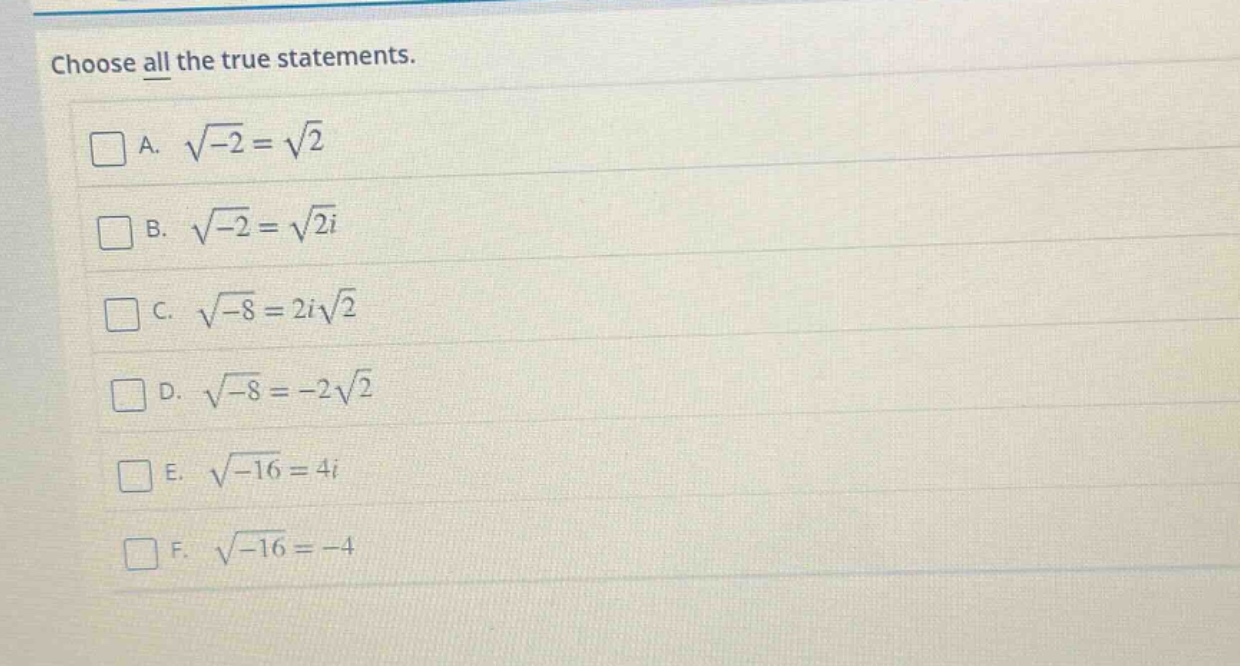
choose all the true statements.\na. $sqrt{-2}=sqrt{2}$\nb. $sqrt{-2}=sqrt{2}i$\nc. $sqrt{-8}=2isqrt{2}$\nd. $sqrt{-8}=-2sqrt{2}$\ne. $sqrt{-16}=4i$\nf. $sqrt{-16}=-4$
Answer
Explanation:
Step1: Recall the definition of imaginary - number square - root
For a non - negative real number (a), (\sqrt{-a}=\sqrt{a}i), where (i = \sqrt{- 1}).
Step2: Analyze option A
The square root of a negative number (\sqrt{-2}) is not equal to (\sqrt{2}) since (\sqrt{2}) is a real number and (\sqrt{-2}) is an imaginary number. So, (\sqrt{-2}\neq\sqrt{2}).
Step3: Analyze option B
Using the rule (\sqrt{-a}=\sqrt{a}i), when (a = 2), (\sqrt{-2}=\sqrt{2}i).
Step4: Analyze option C
For (\sqrt{-8}), we can rewrite (-8) as (-1\times8). Then (\sqrt{-8}=\sqrt{8}\times\sqrt{-1}). Since (\sqrt{8} = 2\sqrt{2}) and (\sqrt{-1}=i), (\sqrt{-8}=2i\sqrt{2}).
Step5: Analyze option D
(\sqrt{-8}) is an imaginary number of the form (2i\sqrt{2}), not (-2\sqrt{2}) (which is a real number). So, (\sqrt{-8}\neq - 2\sqrt{2}).
Step6: Analyze option E
For (\sqrt{-16}), we rewrite (-16) as (-1\times16). Then (\sqrt{-16}=\sqrt{16}\times\sqrt{-1}). Since (\sqrt{16} = 4) and (\sqrt{-1}=i), (\sqrt{-16}=4i).
Step7: Analyze option F
(\sqrt{-16}) is an imaginary number (4i), not (-4) (which is a real number). So, (\sqrt{-16}\neq - 4).
Answer:
B. (\sqrt{-2}=\sqrt{2}i), C. (\sqrt{-8}=2i\sqrt{2}), E. (\sqrt{-16}=4i)