compared with the graph of the parent function, which equation shows only a vertical compression by a factor…
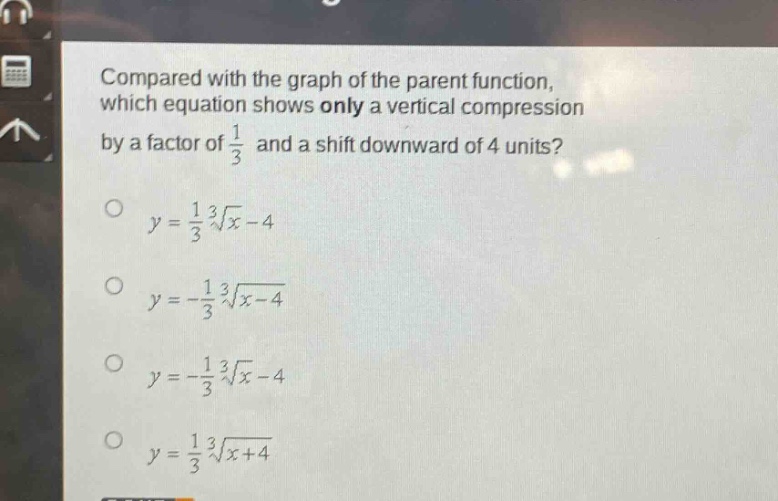
compared with the graph of the parent function, which equation shows only a vertical compression by a factor of $\frac{1}{3}$ and a shift downward of 4 units?\n$y = \frac{1}{3}sqrt3{x}-4$\n$y = -\frac{1}{3}sqrt3{x - 4}$\n$y = -\frac{1}{3}sqrt3{x}-4$\n$y = \frac{1}{3}sqrt3{x + 4}$
Answer
Explanation:
Step1: Comprender la compresión vertical
Una compresión vertical por un factor $a$ en una función $y = f(x)$ se representa como $y = a\cdot f(x)$. Aquí, el factor de compresión es $\frac{1}{3}$, así que tendremos un término $\frac{1}{3}f(x)$.
Step2: Comprender el desplazamiento vertical
Un desplazamiento hacia abajo de $k$ unidades en una función $y = f(x)$ se representa como $y=f(x)-k$. Aquí, $k = 4$, así que tendremos $y=\frac{1}{3}f(x)-4$. Suponiendo que la función padre es $y=\sqrt[3]{x}$, la función resultante es $y=\frac{1}{3}\sqrt[3]{x}-4$.
Answer:
$y=\frac{1}{3}\sqrt[3]{x}-4$ (la primera opción)