which comparison of the two equations is accurate? equation a: $sqrt{x^{2}+3x - 6}=sqrt{x + 2}$ equation b…
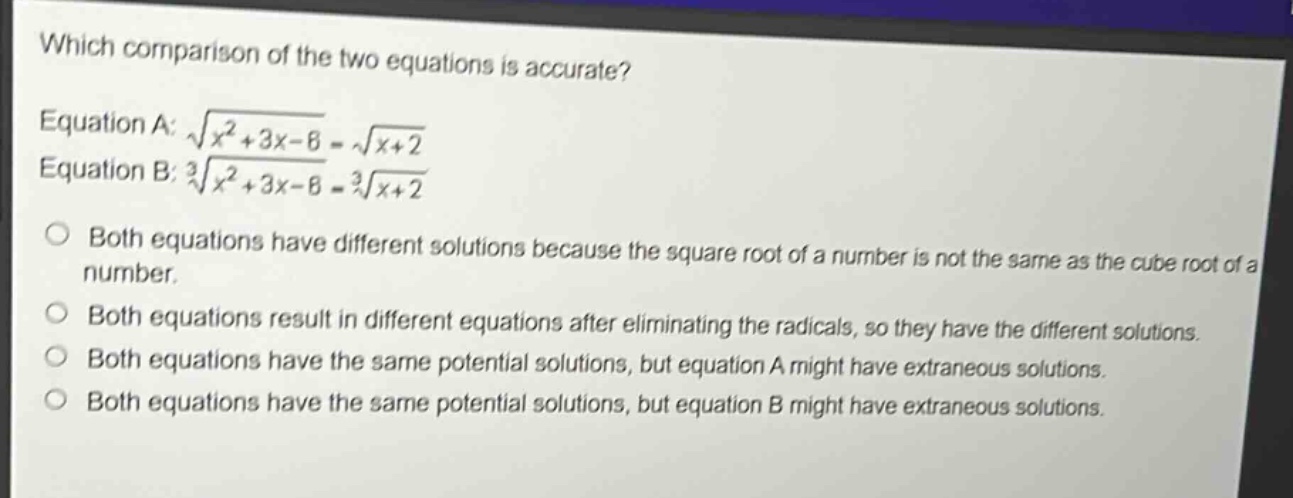
which comparison of the two equations is accurate? equation a: $sqrt{x^{2}+3x - 6}=sqrt{x + 2}$ equation b: $sqrt3{x^{2}+3x - 6}=sqrt3{x + 2}$ both equations have different solutions because the square root of a number is not the same as the cube root of a number. both equations result in different equations after eliminating the radicals, so they have the different solutions. both equations have the same potential solutions, but equation a might have extraneous solutions. both equations have the same potential solutions, but equation b might have extraneous solutions.
Answer
Explanation:
Step1: Recall radical - equation properties
For $\sqrt{f(x)}=\sqrt{g(x)}$, we square both sides to get $f(x) = g(x)$ with the condition $f(x)\geq0$ and $g(x)\geq0$. For $\sqrt[3]{f(x)}=\sqrt[3]{g(x)}$, we cube both sides to get $f(x)=g(x)$ without any non - negativity restrictions on $f(x)$ and $g(x)$. For Equation A: $\sqrt{x^{2}+3x - 6}=\sqrt{x + 2}$, squaring both sides gives $x^{2}+3x-6=x + 2$, or $x^{2}+2x-8 = 0$, and we must have $x^{2}+3x - 6\geq0$ and $x + 2\geq0$. For Equation B: $\sqrt[3]{x^{2}+3x - 6}=\sqrt[3]{x + 2}$, cubing both sides gives $x^{2}+3x-6=x + 2$, or $x^{2}+2x - 8=0$.
Step2: Analyze extraneous solutions
The algebraic manipulations of both equations lead to the same quadratic equation $x^{2}+2x - 8=(x + 4)(x - 2)=0$, so they have the same potential solutions $x=-4$ and $x = 2$. But for Equation A, when $x=-4$, $\sqrt{(-4)^{2}+3\times(-4)-6}=\sqrt{16-12 - 6}=\sqrt{-2}$ and $\sqrt{-4 + 2}=\sqrt{-2}$ are not real numbers in the set of real - valued square roots (since the expressions inside the square roots are negative). So Equation A might have extraneous solutions due to the non - negativity requirement of square roots.
Answer:
C. Both equations have the same potential solutions, but equation A might have extraneous solutions.