complete the following for each pair of vectors. do not round any intermediate computations. round your…
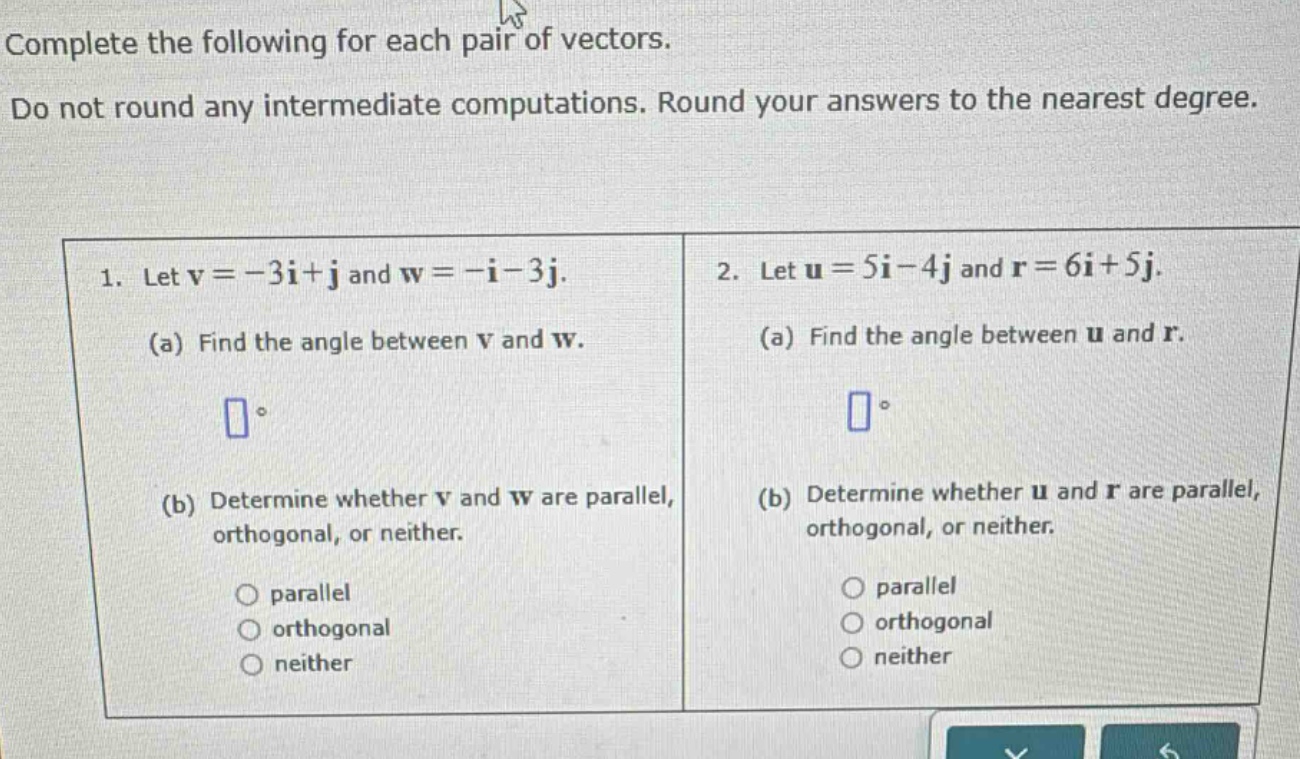
complete the following for each pair of vectors. do not round any intermediate computations. round your answers to the nearest degree. 1. let v = -3i + j and w = -i - 3j. (a) find the angle between v and w. (b) determine whether v and w are parallel, orthogonal, or neither. parallel orthogonal neither 2. let u = 5i - 4j and r = 6i + 5j. (a) find the angle between u and r. (b) determine whether u and r are parallel, orthogonal, or neither. parallel orthogonal neither
Answer
Explanation:
Step1: Recall the dot - product formula
The dot - product of two vectors $\mathbf{a}=a_1\mathbf{i}+a_2\mathbf{j}$ and $\mathbf{b}=b_1\mathbf{i}+b_2\mathbf{j}$ is $\mathbf{a}\cdot\mathbf{b}=a_1b_1 + a_2b_2$, and $\mathbf{a}\cdot\mathbf{b}=\vert\mathbf{a}\vert\vert\mathbf{b}\vert\cos\theta$, where $\theta$ is the angle between the two vectors, and $\vert\mathbf{a}\vert=\sqrt{a_1^{2}+a_2^{2}}$, $\vert\mathbf{b}\vert=\sqrt{b_1^{2}+b_2^{2}}$.
Step2: Calculate for $\mathbf{v}=-3\mathbf{i}+\mathbf{j}$ and $\mathbf{w}=-\mathbf{i}-3\mathbf{j}$
Calculate the dot - product
$\mathbf{v}\cdot\mathbf{w}=(-3)\times(-1)+1\times(-3)=3 - 3=0$.
Calculate the magnitudes
$\vert\mathbf{v}\vert=\sqrt{(-3)^{2}+1^{2}}=\sqrt{9 + 1}=\sqrt{10}$, $\vert\mathbf{w}\vert=\sqrt{(-1)^{2}+(-3)^{2}}=\sqrt{1 + 9}=\sqrt{10}$.
Find the angle
Since $\mathbf{v}\cdot\mathbf{w}=\vert\mathbf{v}\vert\vert\mathbf{w}\vert\cos\theta$, then $0=\sqrt{10}\times\sqrt{10}\cos\theta$, so $\cos\theta = 0$. Thus, $\theta = 90^{\circ}$.
Determine the relationship
Since $\mathbf{v}\cdot\mathbf{w}=0$, $\mathbf{v}$ and $\mathbf{w}$ are orthogonal.
Step3: Calculate for $\mathbf{u}=5\mathbf{i}-4\mathbf{j}$ and $\mathbf{r}=6\mathbf{i}+5\mathbf{j}$
Calculate the dot - product
$\mathbf{u}\cdot\mathbf{r}=5\times6+(-4)\times5=30-20 = 10$.
Calculate the magnitudes
$\vert\mathbf{u}\vert=\sqrt{5^{2}+(-4)^{2}}=\sqrt{25 + 16}=\sqrt{41}$, $\vert\mathbf{r}\vert=\sqrt{6^{2}+5^{2}}=\sqrt{36+25}=\sqrt{61}$.
Find the angle
$\cos\theta=\frac{\mathbf{u}\cdot\mathbf{r}}{\vert\mathbf{u}\vert\vert\mathbf{r}\vert}=\frac{10}{\sqrt{41}\times\sqrt{61}}\approx\frac{10}{\sqrt{2501}}\approx\frac{10}{50.01}\approx0.2$. Then $\theta=\cos^{-1}(0.2)\approx79^{\circ}$.
Determine the relationship
Since $\mathbf{u}\cdot\mathbf{r}\neq0$ and there is no scalar $k$ such that $\mathbf{u}=k\mathbf{r}$ (i.e., $\frac{5}{6}\neq\frac{-4}{5}$), $\mathbf{u}$ and $\mathbf{r}$ are neither parallel nor orthogonal.
Answer:
- (a) $90$ (b) orthogonal
- (a) $79$ (b) neither