complete the statements. graph has one real root. graph has a negative discriminant. graph has an equation…
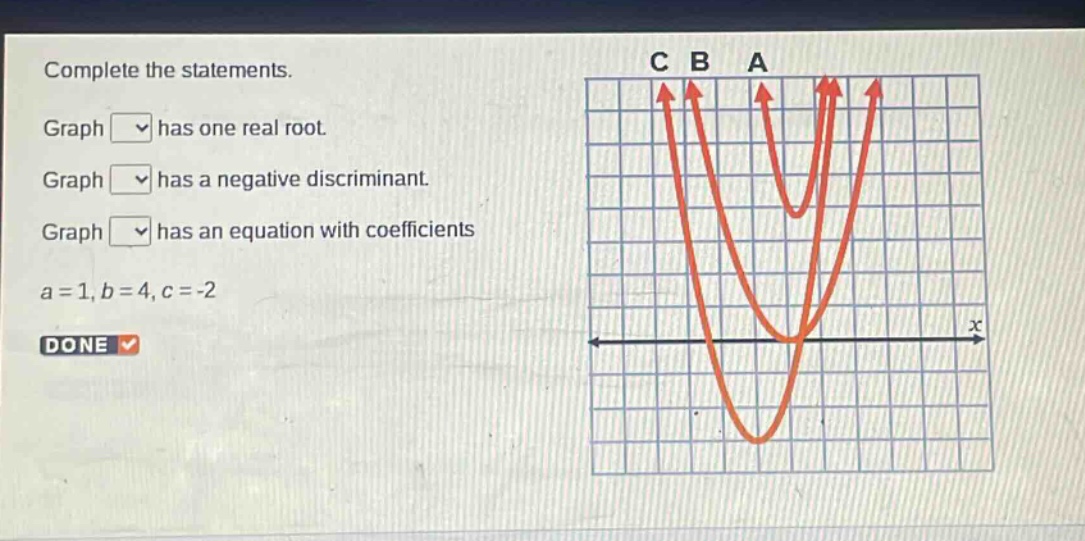
complete the statements. graph has one real root. graph has a negative discriminant. graph has an equation with coefficients a = 1, b = 4, c = -2 done
Answer
Explanation:
Step1: Recall root - discriminant relationship
The number of real roots of a quadratic function (y = ax^{2}+bx + c) is determined by the discriminant (\Delta=b^{2}-4ac). If (\Delta = 0), the function has one real root; if (\Delta<0), the function has no real roots; if (\Delta>0), the function has two real roots.
Step2: Analyze graph for one real root
A quadratic graph that touches the (x -)axis at exactly one point has one real root. From the graph, graph B touches the (x -)axis at one point, so graph B has one real root.
Step3: Analyze graph for negative discriminant
A quadratic graph that does not intersect the (x -)axis has a negative discriminant. Graph C does not intersect the (x -)axis, so graph C has a negative discriminant.
Step4: Calculate discriminant for (a = 1), (b = 4), (c=-2)
First, calculate the discriminant (\Delta=b^{2}-4ac). Substitute (a = 1), (b = 4), (c=-2) into the formula: (\Delta=(4)^{2}-4\times1\times(-2)=16 + 8=24>0). A graph with two real - roots corresponds to this equation. Graph A has two real roots.
Answer:
Graph B has one real root. Graph C has a negative discriminant. Graph A has an equation with coefficients (a = 1), (b = 4), (c=-2).