what is the completely factored form of $f(x)=x^{3}-2x^{2}-5x + 6$?\n$f(x)=(x + 2)(x - 3)(x + 6)$\n$f(x)=(x…
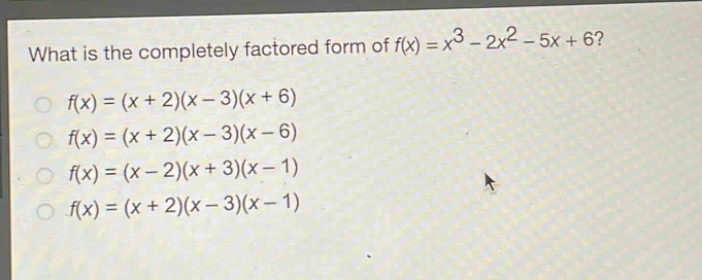
what is the completely factored form of $f(x)=x^{3}-2x^{2}-5x + 6$?\n$f(x)=(x + 2)(x - 3)(x + 6)$\n$f(x)=(x + 2)(x - 3)(x - 6)$\n$f(x)=(x - 2)(x + 3)(x - 1)$\n$f(x)=(x + 2)(x - 3)(x - 1)$
Answer
Explanation:
Step1: Use the Rational Root Theorem
The Rational Root Theorem states that if a polynomial (a_nx^n + a_{n - 1}x^{n-1}+\cdots+a_1x + a_0) has a rational root (p/q), then (p) is a factor of the constant term (a_0) and (q) is a factor of the leading - coefficient (a_n). For the polynomial (f(x)=x^{3}-2x^{2}-5x + 6), (a_n = 1) and (a_0=6). The possible rational roots are (\pm1,\pm2,\pm3,\pm6).
Step2: Test the possible roots
Let's test (x = 1): (f(1)=1^{3}-2\times1^{2}-5\times1 + 6=1 - 2-5 + 6=0). Since (f(1) = 0), ((x - 1)) is a factor of (f(x)).
Step3: Perform polynomial long - division
Divide (x^{3}-2x^{2}-5x + 6) by ((x - 1)). Using polynomial long - division: (x^{3}-2x^{2}-5x + 6=(x - 1)(x^{2}-x - 6)).
Step4: Factor the quadratic polynomial
Factor (x^{2}-x - 6). We need to find two numbers that multiply to (-6) and add up to (-1). The numbers are (-3) and (2). So (x^{2}-x - 6=(x - 3)(x+2)).
Step5: Write the completely factored form
(f(x)=(x - 1)(x - 3)(x + 2)).
Answer:
(f(x)=(x + 2)(x - 3)(x - 1))