the composition $d_{0,\frac{3}{2}}(x,y)circ d_{0,\frac{1}{2}}(x,y)$ is applied to $\triangle rst$ to create…
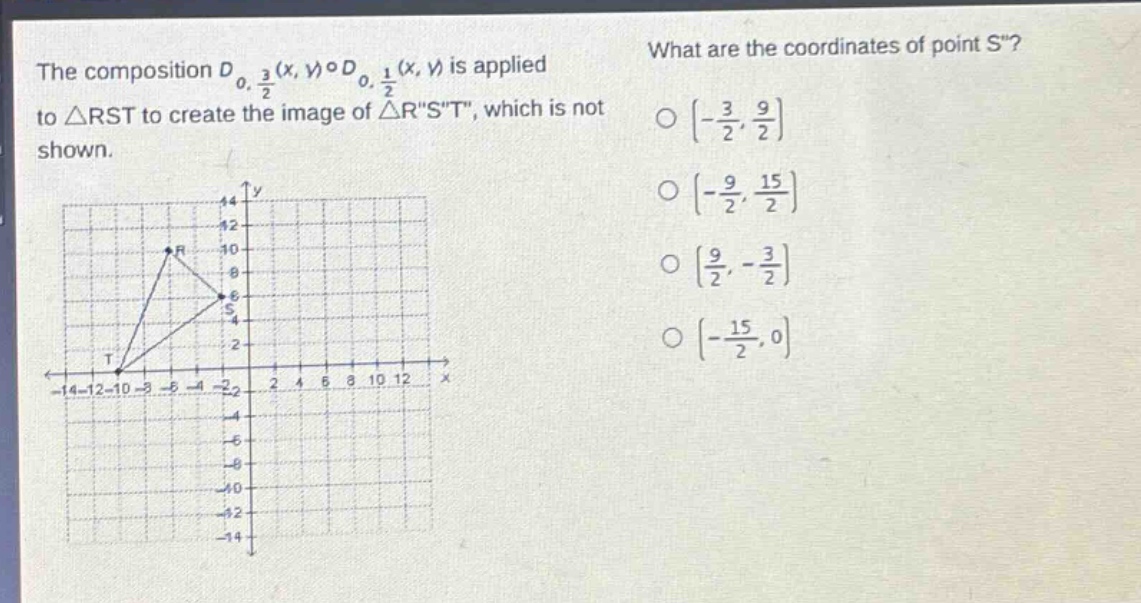
the composition $d_{0,\frac{3}{2}}(x,y)circ d_{0,\frac{1}{2}}(x,y)$ is applied to $\triangle rst$ to create the image of $\triangle rst$, which is not shown. what are the coordinates of point $s$? $\\left(-\\frac{3}{2},\\frac{9}{2}\\right)$ $\\left(-\\frac{9}{2},\\frac{15}{2}\\right)$ $\\left(\\frac{9}{2},-\\frac{3}{2}\\right)$ $\\left(-\\frac{15}{2},0\\right)$
Answer
- First, recall the rule for a dilation centered at the origin:
- The rule for a dilation (D_{k}(x,y)=(kx,ky)) where (k) is the scale - factor.
- If we have a composition of dilations (D_{k_1}(x,y)\circ D_{k_2}(x,y)), and we apply (D_{k_2}(x,y)) first and then (D_{k_1}(x,y)) to a point ((x,y)), the combined transformation is (D_{k_1}(D_{k_2}(x,y)) = D_{k_1}(k_2x,k_2y)=(k_1k_2x,k_1k_2y)).
- Given (k_1 = \frac{3}{2}) and (k_2=\frac{1}{2}), then (k = k_1k_2=\frac{3}{2}\times\frac{1}{2}=\frac{3}{4}).
- Locate the coordinates of point (S) from the graph:
- From the graph, the coordinates of point (S) are (( - 6,5)).
- Apply the dilation rule:
- Using the rule (D_{k}(x,y)=(kx,ky)) with (k = \frac{3}{4}), we substitute (x=-6) and (y = 5).
- For the (x) - coordinate: (x'=\frac{3}{4}\times(-6)=-\frac{18}{4}=-\frac{9}{2}).
- For the (y) - coordinate: (y'=\frac{3}{4}\times5=\frac{15}{4}).
- However, if we consider the composition of dilations (D_{0,\frac{3}{2}}\circ D_{0,\frac{1}{2}}) in the correct order of application (first (D_{0,\frac{1}{2}}) then (D_{0,\frac{3}{2}})):
- First, applying (D_{0,\frac{1}{2}}) to the point (S(-6,5)), we get (S_1=\left(\frac{1}{2}\times(-6),\frac{1}{2}\times5\right)=(-3,\frac{5}{2})).
- Then, applying (D_{0,\frac{3}{2}}) to (S_1(-3,\frac{5}{2})), we have (x=\frac{3}{2}\times(-3)=-\frac{9}{2}) and (y=\frac{3}{2}\times\frac{5}{2}=\frac{15}{2}).
Answer:
(\left(-\frac{9}{2},\frac{15}{2}\right))