which composition of similarity transformations would map polygon abdc to polygon abdc?\n a dilation with a…
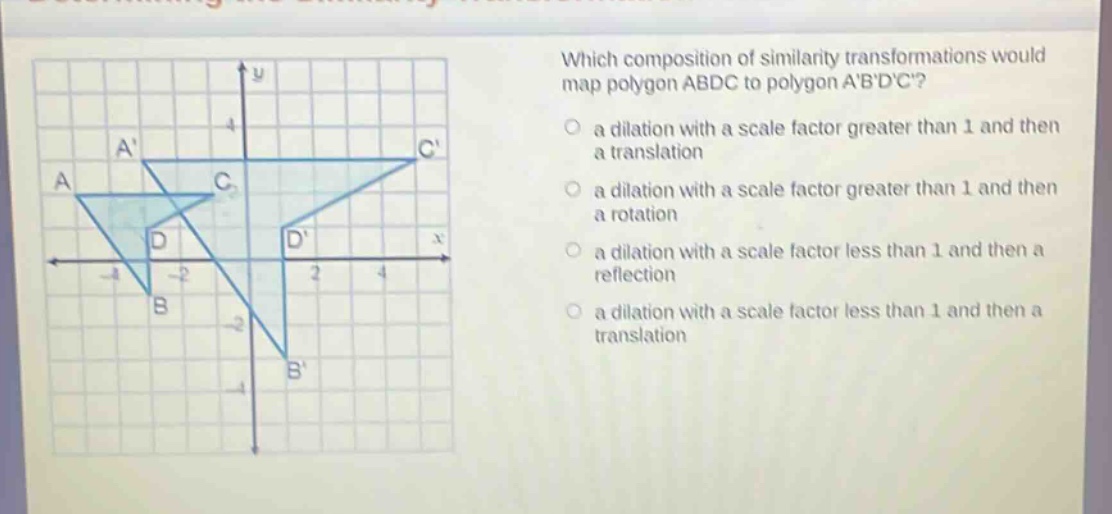
which composition of similarity transformations would map polygon abdc to polygon abdc?\n a dilation with a scale factor greater than 1 and then a translation\n a dilation with a scale factor greater than 1 and then a rotation\n a dilation with a scale factor less than 1 and then a reflection\n a dilation with a scale factor less than 1 and then a translation
Answer
Explanation:
Step1: Observe the size change
Polygon A'B'D'C' is larger than polygon ABDC, so a dilation with a scale - factor greater than 1 is needed first.
Step2: Observe the orientation and position
The orientation of the two polygons is the same, and the position of A'B'D'C' is shifted relative to ABDC. So a translation is required after dilation.
Answer:
a dilation with a scale factor greater than 1 and then a translation