concentric circles with center g have radii 5 and 11 as shown. which would prove that the circles are…
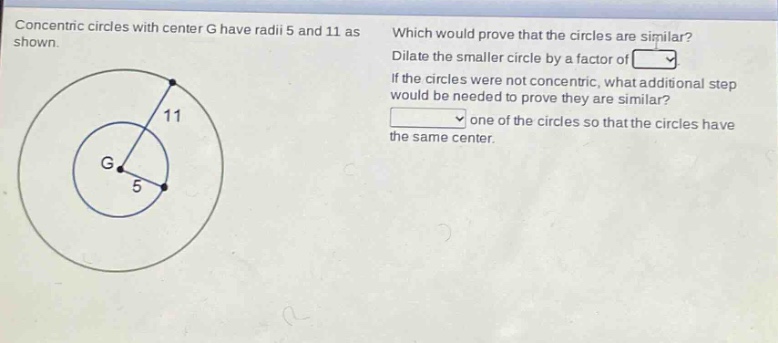
concentric circles with center g have radii 5 and 11 as shown. which would prove that the circles are similar? dilate the smaller circle by a factor of . if the circles were not concentric, what additional step would be needed to prove they are similar? one of the circles so that the circles have the same center.
Answer
Answer:
- $\frac{11}{5}$
- Translate
Explanation:
Step1: Find dilation factor
The ratio of the radii of the two circles gives the dilation factor. For a circle with radius $r_1 = 5$ and another with radius $r_2=11$, the dilation factor $k=\frac{r_2}{r_1}=\frac{11}{5}$.
Step2: Determine additional step
If two non - concentric circles are to be shown similar, we can translate (move) one of the circles so that they have the same center. Then we can apply a dilation to map one circle onto the other.