which of these conditions might be true if polygons abcd and klmn are similar?\n\na. the measures of…
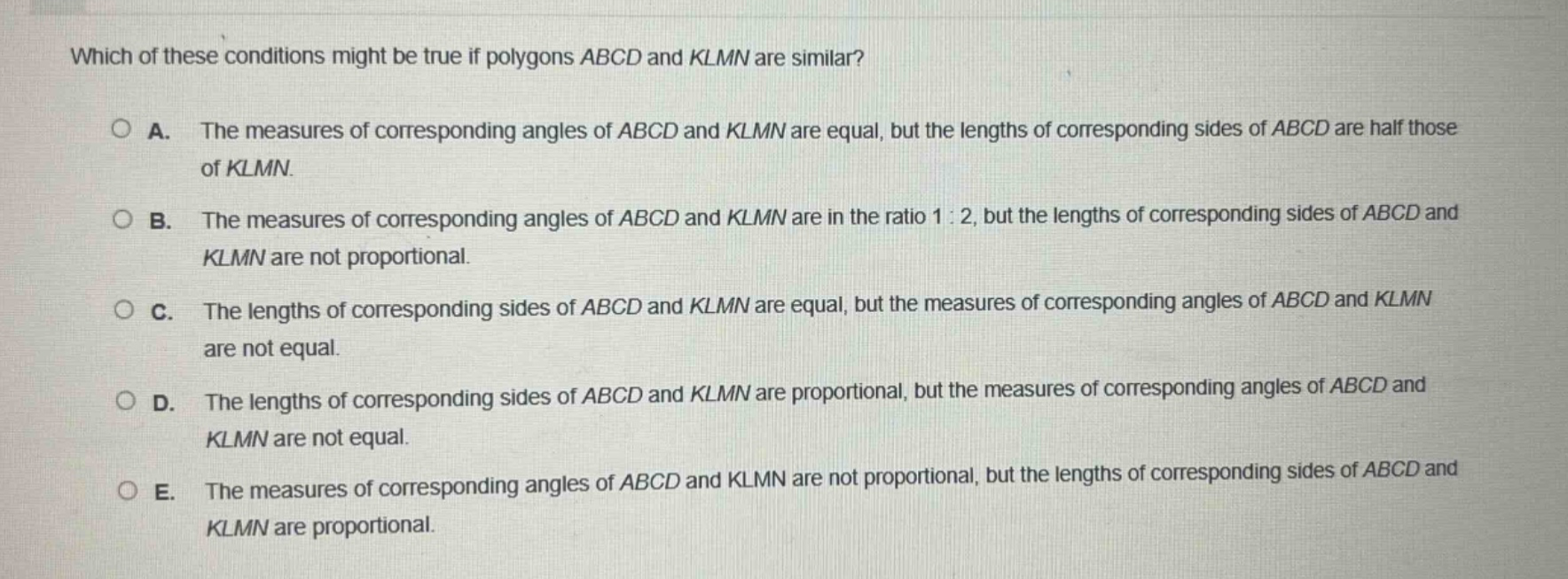
which of these conditions might be true if polygons abcd and klmn are similar?\n\na. the measures of corresponding angles of abcd and klmn are equal, but the lengths of corresponding sides of abcd are half those of klmn.\n\nb. the measures of corresponding angles of abcd and klmn are in the ratio 1:2, but the lengths of corresponding sides of abcd and klmn are not proportional.\n\nc. the lengths of corresponding sides of abcd and klmn are equal, but the measures of corresponding angles of abcd and klmn are not equal.\n\nd. the lengths of corresponding sides of abcd and klmn are proportional, but the measures of corresponding angles of abcd and klmn are not equal.\n\ne. the measures of corresponding angles of abcd and klmn are not proportional, but the lengths of corresponding sides of abcd and klmn are proportional.
Answer
Explanation:
Step1: Recall similarity criteria
For two polygons to be similar, corresponding - angles must be equal and corresponding - sides must be proportional.
Step2: Analyze option A
In option A, the measures of corresponding angles of (ABCD) and (KLMN) are equal, and the lengths of corresponding sides of (ABCD) are half those of (KLMN). This means the sides are proportional (with a scale - factor of (\frac{1}{2})). So, this option satisfies the similarity criteria.
Step3: Analyze option B
If the measures of corresponding angles are in the ratio (1:2), they are not equal. And if the lengths of corresponding sides are not proportional, the polygons are not similar.
Step4: Analyze option C
If the lengths of corresponding sides are equal (congruent sides), but the measures of corresponding angles are not equal, the polygons are not similar.
Step5: Analyze option D
If the lengths of corresponding sides are proportional but the measures of corresponding angles are not equal, the polygons are not similar.
Step6: Analyze option E
If the measures of corresponding angles are not proportional (which implies they are not equal) and only the lengths of corresponding sides are proportional, the polygons are not similar.
Answer:
A. The measures of corresponding angles of (ABCD) and (KLMN) are equal, but the lengths of corresponding sides of (ABCD) are half those of (KLMN).