consider a circle whose equation is $x^{2}+y^{2}-2x - 8 = 0$. which statements are true? select three…
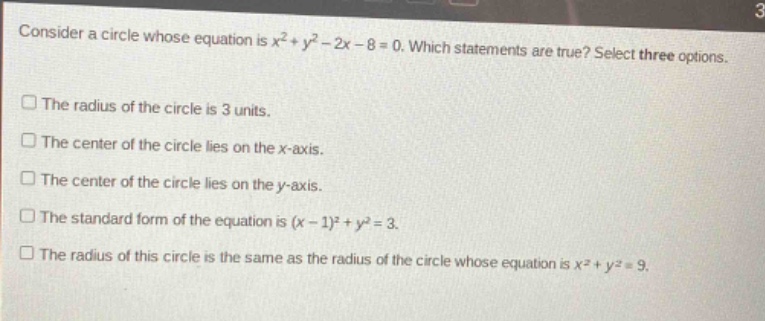
consider a circle whose equation is $x^{2}+y^{2}-2x - 8 = 0$. which statements are true? select three options.\nthe radius of the circle is 3 units.\nthe center of the circle lies on the x - axis.\nthe center of the circle lies on the y - axis.\nthe standard form of the equation is $(x - 1)^{2}+y^{2}=3$.\nthe radius of this circle is the same as the radius of the circle whose equation is $x^{2}+y^{2}=9$.
Answer
Explanation:
Step1: Convert to standard - form
The general equation of a circle is (x^{2}+y^{2}+Dx + Ey+F = 0), and its standard - form is ((x - a)^{2}+(y - b)^{2}=r^{2}), where ((a,b)) is the center of the circle and (r) is the radius. Given (x^{2}+y^{2}-2x - 8 = 0), we complete the square for the (x) terms. (x^{2}-2x=(x - 1)^{2}-1). So the equation becomes ((x - 1)^{2}-1+y^{2}-8 = 0), which simplifies to ((x - 1)^{2}+y^{2}=9).
Step2: Identify the center and radius
For the circle ((x - 1)^{2}+y^{2}=9), the center is ((1,0)) and the radius (r = 3) (since (r^{2}=9), so (r = 3)).
Step3: Analyze each option
- Option 1: The radius of the circle is 3 units. Since (r^{2}=9) and (r>0), (r = 3), this option is true.
- Option 2: The center of the circle is ((1,0)), which lies on the (x) - axis ((y = 0)), so this option is true.
- Option 3: The center ((1,0)) does not lie on the (y) - axis ((x\neq0)), so this option is false.
- Option 4: The standard form is ((x - 1)^{2}+y^{2}=9), not ((x - 1)^{2}+y^{2}=3), so this option is false.
- Option 5: The radius of the circle (x^{2}+y^{2}=9) is also (r = 3) (since (r^{2}=9) and (r>0)), so this option is true.
Answer:
The radius of the circle is 3 units. The center of the circle lies on the x - axis. The radius of this circle is the same as the radius of the circle whose equation is (x^{2}+y^{2}=9).