consider this conditional statement.\nif an object is 100 centimeters long, then the object is 1 meter…
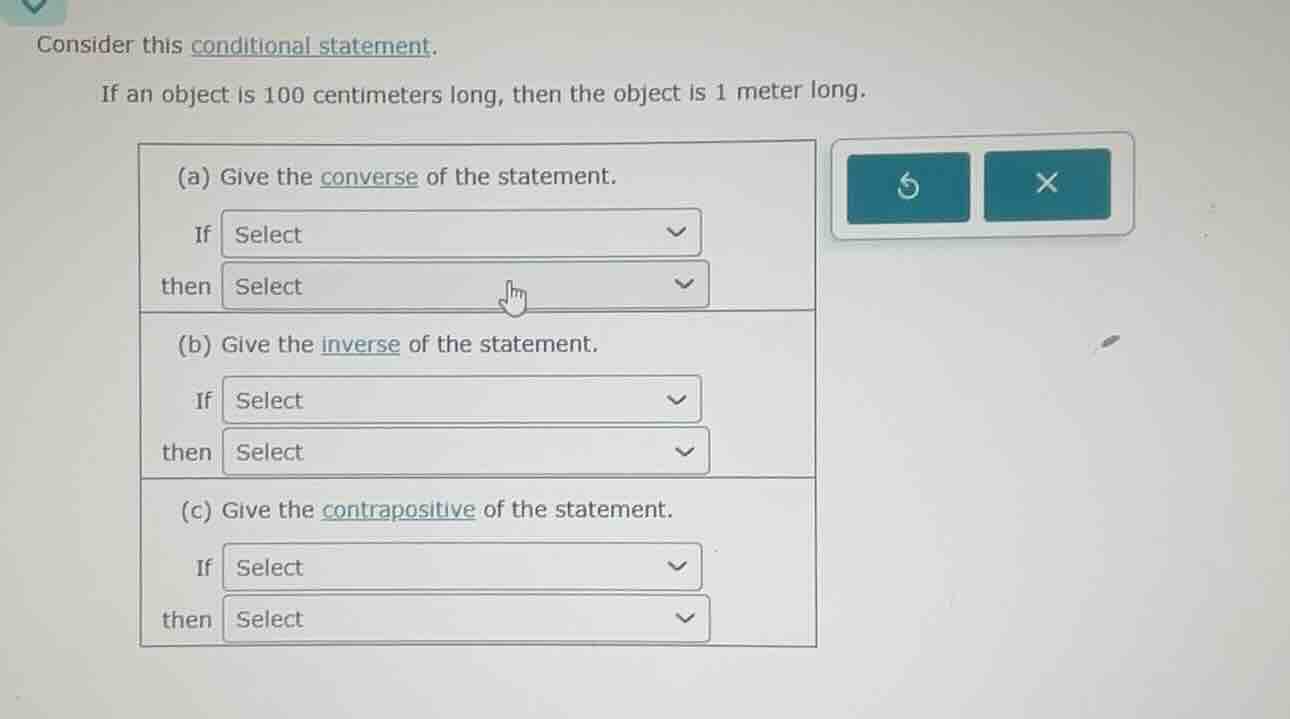
consider this conditional statement.\nif an object is 100 centimeters long, then the object is 1 meter long.\n(a) give the converse of the statement.\nif select\nthen select\n(b) give the inverse of the statement.\nif select\nthen select\n(c) give the contrapositive of the statement.\nif select\nthen select
Answer
Brief Explanations:
The original conditional statement is "If $P$, then $Q$", where $P$ is "an object is 100 centimeters long" and $Q$ is "the object is 1 meter long". (a) The converse is "If $Q$, then $P$". (b) The inverse is "If not $P$, then not $Q$". (c) The contrapositive is "If not $Q$, then not $P$".
Answer:
(a) If the object is 1 meter long, then the object is 100 centimeters long. (b) If an object is not 100 centimeters long, then the object is not 1 meter long. (c) If the object is not 1 meter long, then the object is not 100 centimeters long.