consider the equation below.\n$log_{4}(x + 3)=log_{2}(2 + x)$\nwhich system of equations can represent the…
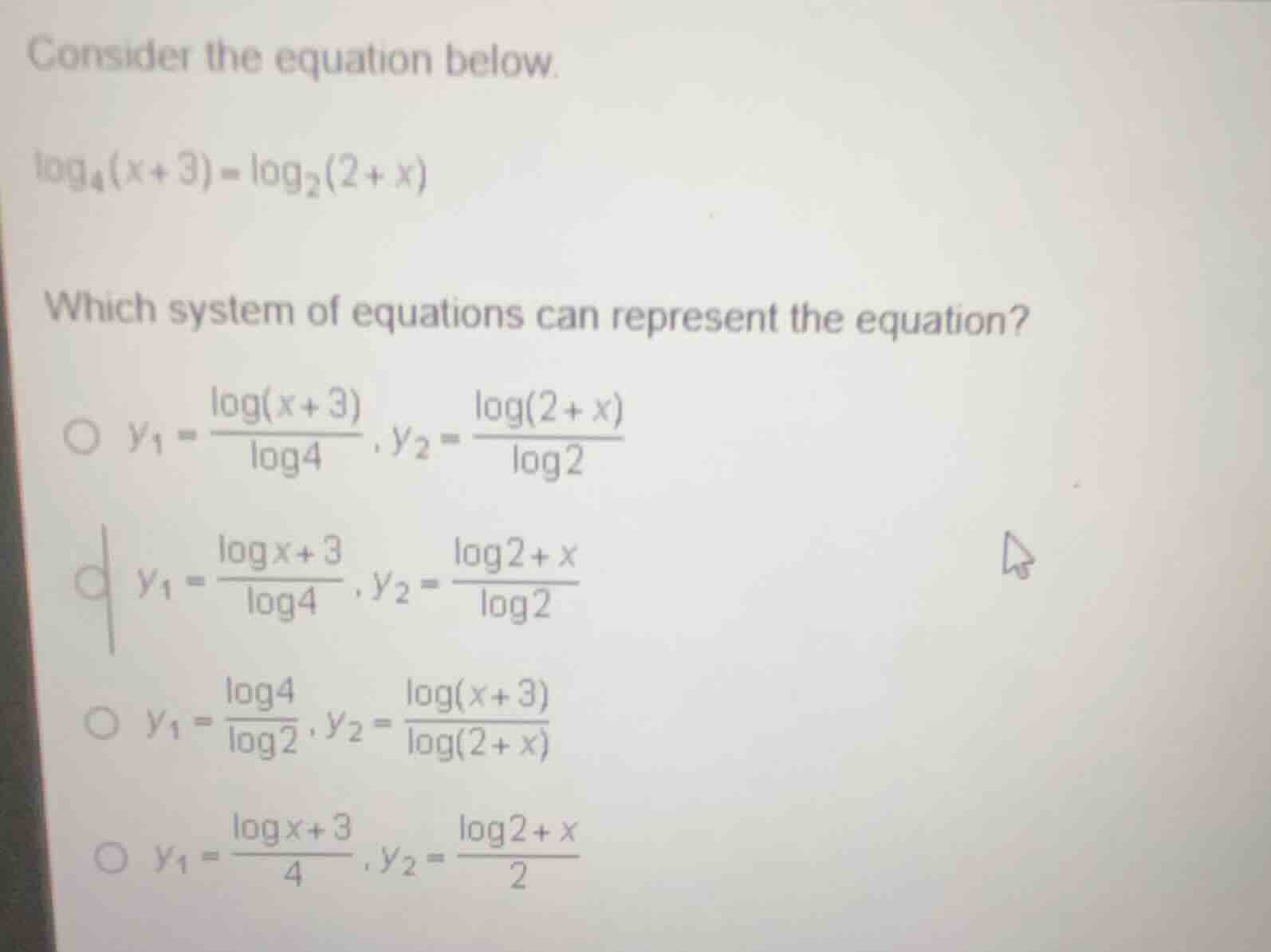
consider the equation below.\n$log_{4}(x + 3)=log_{2}(2 + x)$\nwhich system of equations can represent the equation?\n$\\bigcirc\\ y_{1}=\\frac{\\log(x + 3)}{\\log4},y_{2}=\\frac{\\log(2 + x)}{\\log2}$\n$\\bigcirc\\ y_{1}=\\frac{\\log x + 3}{\\log4},y_{2}=\\frac{\\log2 + x}{\\log2}$\n$\\bigcirc\\ y_{1}=\\frac{\\log4}{\\log2},y_{2}=\\frac{\\log(x + 3)}{\\log(2 + x)}$\n$\\bigcirc\\ y_{1}=\\frac{\\log x + 3}{4},y_{2}=\\frac{\\log2 + x}{2}$
Answer
Explanation:
Step1: Recall Change of Base Formula
The change of base formula for logarithms is $\log_b a = \frac{\log_c a}{\log_c b}$ (where $c>0, c\neq1$). For the left - hand side $\log_4(x + 3)$, using the change of base formula with base 10 (common logarithm), we have $\log_4(x + 3)=\frac{\log(x + 3)}{\log4}$. Let $y_1=\log_4(x + 3)$, so $y_1=\frac{\log(x + 3)}{\log4}$.
Step2: Apply Change of Base to the Right - Hand Side
For the right - hand side $\log_2(2 + x)$, using the change of base formula with base 10, we get $\log_2(2 + x)=\frac{\log(2 + x)}{\log2}$. Let $y_2=\log_2(2 + x)$, so $y_2=\frac{\log(2 + x)}{\log2}$.
Step3: Analyze the Options
- Option 2: $\log x+3$ is incorrect. The argument of the logarithm is $x + 3$, so it should be $\log(x + 3)$, not $\log x+3$. Similarly for the right - hand side.
- Option 3: The expressions for $y_1$ and $y_2$ do not match the change of base application for the given equation.
- Option 4: The expressions $\frac{\log x + 3}{4}$ and $\frac{\log 2+x}{2}$ are incorrect as they do not follow the change of base formula.
- Option 1: $y_1=\frac{\log(x + 3)}{\log4}$ and $y_2=\frac{\log(2 + x)}{\log2}$ is correct as it follows the change of base formula for $\log_4(x + 3)$ and $\log_2(2 + x)$ respectively.
Answer:
A. $y_{1}=\frac{\log(x + 3)}{\log4},y_{2}=\frac{\log(2 + x)}{\log2}$