consider the exponential function $f(x)=3(\\frac{1}{3})^x$ and its graph. which statements are true for this…
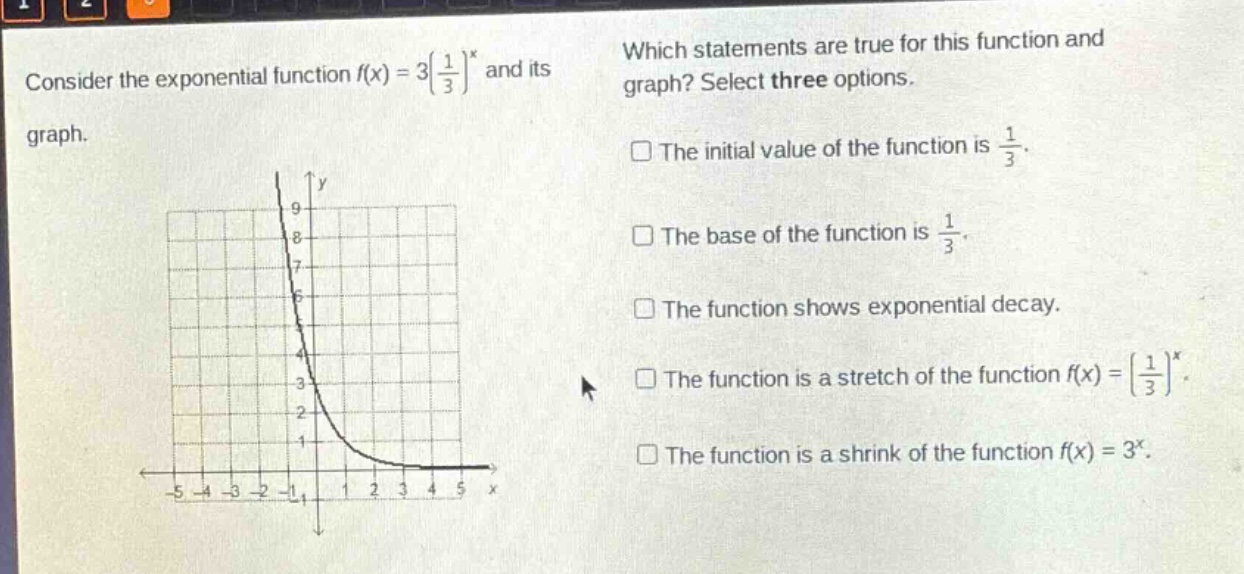
consider the exponential function $f(x)=3(\\frac{1}{3})^x$ and its graph. which statements are true for this function and graph? select three options. the initial value of the function is $\\frac{1}{3}$. the base of the function is $\\frac{1}{3}$. the function shows exponential decay. the function is a stretch of the function $f(x)=(\\frac{1}{3})^x$. the function is a shrink of the function $f(x)=3^x$.
Answer
Explanation:
Step1: Recall the form of exponential function
The general form of an exponential function is $y = a\cdot b^{x}$, where $a$ is the initial - value and $b$ is the base. For the function $f(x)=3(\frac{1}{3})^{x}$, when $x = 0$, $f(0)=3(\frac{1}{3})^{0}=3\times1 = 3$, so the initial - value is 3, not $\frac{1}{3}$.
Step2: Identify the base
For the function $f(x)=3(\frac{1}{3})^{x}$, the base $b=\frac{1}{3}$. Since $0 < b=\frac{1}{3}<1$, the function shows exponential decay.
Step3: Analyze the transformation
The function $y = (\frac{1}{3})^{x}$ is multiplied by 3, so the function $f(x)=3(\frac{1}{3})^{x}$ is a vertical stretch of the function $y = (\frac{1}{3})^{x}$ by a factor of 3. The function $f(x)=3(\frac{1}{3})^{x}=3\times3^{-x}=3^{1 - x}$, and it is not a shrink of $f(x)=3^{x}$.
Answer:
B. The base of the function is $\frac{1}{3}$. C. The function shows exponential decay. D. The function is a stretch of the function $f(x)=(\frac{1}{3})^{x}$.