consider the following function: $f(x)=\frac{25 - x^{2}}{x^{2}-4x - 5}$ which of the following are correct…
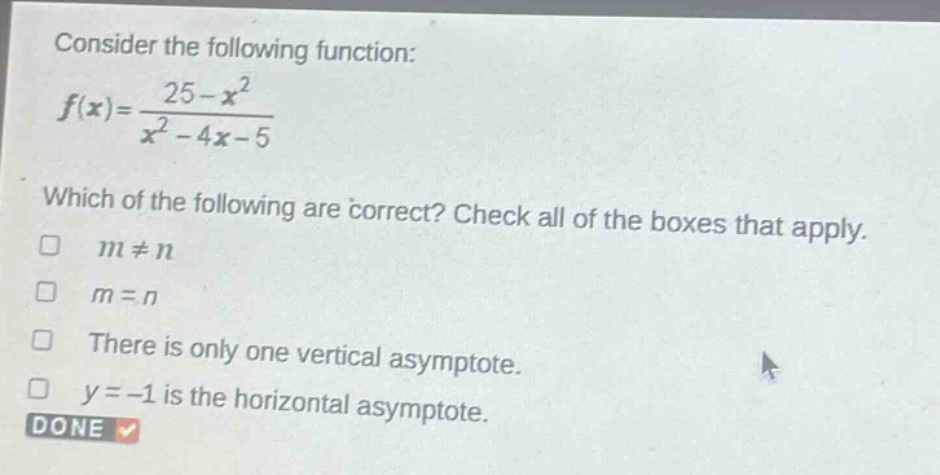
consider the following function: $f(x)=\frac{25 - x^{2}}{x^{2}-4x - 5}$ which of the following are correct? check all of the boxes that apply. $m\neq n$ $m = n$ there is only one vertical asymptote. $y=-1$ is the horizontal asymptote. done
Answer
Explanation:
Step1: Factor the function
First, factor the numerator and denominator. The numerator (25 - x^{2}=(5 + x)(5 - x)) using the difference - of - squares formula (a^{2}-b^{2}=(a + b)(a - b)) with (a = 5) and (b=x). The denominator (x^{2}-4x - 5=(x-5)(x + 1)) using the fact that for (ax^{2}+bx + c) ((a = 1), (b=-4), (c=-5)), we find two numbers that multiply to (ac=-5) and add up to (b=-4), which are (-5) and (1). So (f(x)=\frac{(5 + x)(5 - x)}{(x - 5)(x + 1)}=-\frac{(x + 5)(x - 5)}{(x - 5)(x + 1)}=-\frac{x + 5}{x+1},x\neq5)
Step2: Find vertical asymptotes
Vertical asymptotes occur where the denominator of the simplified function is zero. Set (x + 1=0), then (x=-1) is the vertical asymptote.
Step3: Find horizontal asymptotes
For a rational function (y=\frac{f(x)}{g(x)}) where (f(x)) and (g(x)) are polynomials of degree (m) and (n) respectively. Here, the degree of the numerator and denominator of the simplified function (y =-\frac{x + 5}{x+1}) is (m = n=1). We use the rule that if (m = n), the horizontal asymptote is (y=\frac{a_{m}}{b_{n}}), where (a_{m}) and (b_{n}) are the leading coefficients of the numerator and denominator. The leading coefficient of the numerator is (- 1) and the leading coefficient of the denominator is (1), so (y=-1) is the horizontal asymptote.
Answer:
There is only one vertical asymptote, (y=-1) is the horizontal asymptote.