consider the functions $f(x)=3x^{2}$, $g(x)=\frac{1}{3x}$, and $h(x)=3x$. which statements accurately…
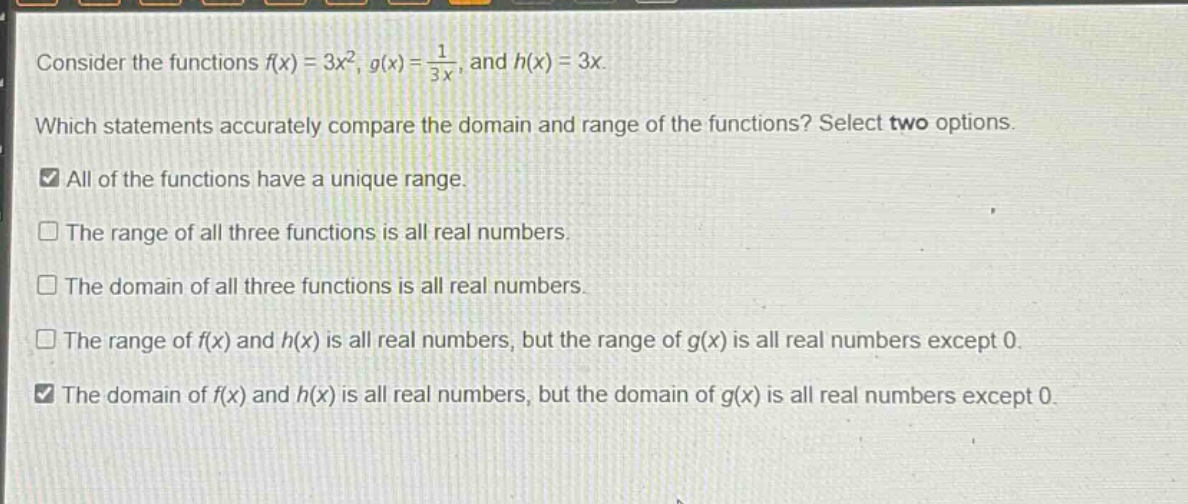
consider the functions $f(x)=3x^{2}$, $g(x)=\frac{1}{3x}$, and $h(x)=3x$. which statements accurately compare the domain and range of the functions? select two options. all of the functions have a unique range. the range of all three functions is all real numbers. the domain of all three functions is all real numbers. the range of $f(x)$ and $h(x)$ is all real numbers, but the range of $g(x)$ is all real numbers except 0. the domain of $f(x)$ and $h(x)$ is all real numbers, but the domain of $g(x)$ is all real numbers except 0.
Answer
Explanation:
Step1: Analyze domain of $f(x) = 3x^{2}$
A polynomial function like $f(x)$ has domain of all real - numbers since we can substitute any real number for $x$.
Step2: Analyze domain of $g(x)=\frac{1}{3x}$
The function $g(x)$ is a rational function. The denominator cannot be zero. So $3x\neq0$, which means $x\neq0$. The domain of $g(x)$ is all real numbers except $0$.
Step3: Analyze domain of $h(x) = 3x$
$h(x)$ is a linear polynomial. Its domain is all real numbers.
Step4: Analyze range of $f(x)=3x^{2}$
Since $x^{2}\geq0$ for all real $x$, then $3x^{2}\geq0$. The range of $f(x)$ is $y\geq0$.
Step5: Analyze range of $g(x)=\frac{1}{3x}$
As $x$ approaches $0$ from the positive side, $g(x)$ approaches $+\infty$, and as $x$ approaches $0$ from the negative side, $g(x)$ approaches $-\infty$. But $g(x)$ can never be $0$. The range of $g(x)$ is all real numbers except $0$.
Step6: Analyze range of $h(x)=3x$
$h(x)$ is a linear function and can output any real number. The range of $h(x)$ is all real numbers.
Answer:
All of the functions have a unique range. The domain of $f(x)$ and $h(x)$ is all real numbers, but the domain of $g(x)$ is all real numbers except $0$.