consider kite abcd. what are the values of x and y? o x = 2, y = 22 o x = 2, y = 44 o x = 5, y = 22 o x = 5…
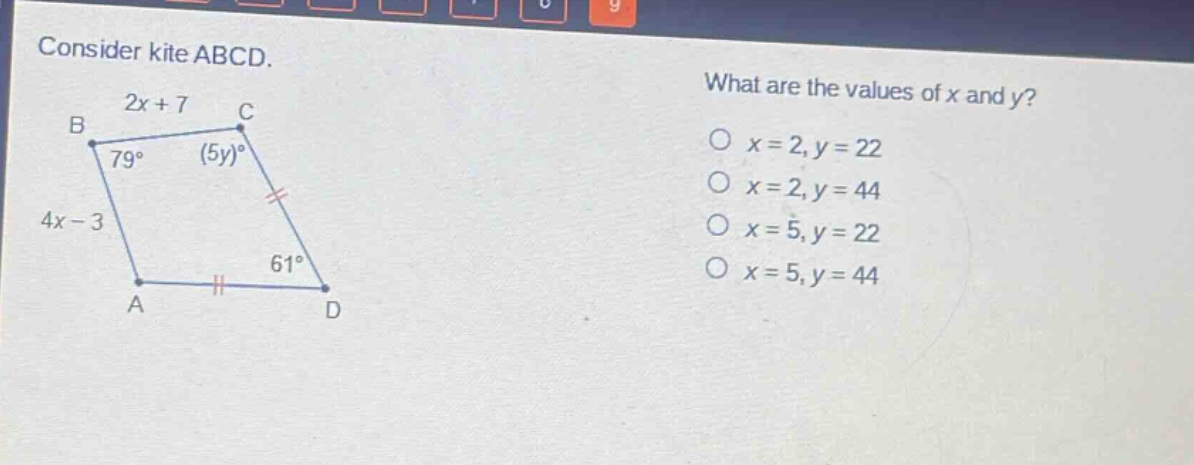
consider kite abcd. what are the values of x and y? o x = 2, y = 22 o x = 2, y = 44 o x = 5, y = 22 o x = 5, y = 44
Answer
Explanation:
Step1: Use property of kite - adjacent sides are equal
In a kite, two pairs of adjacent sides are equal. So, (AB = AD). We set up the equation (4x - 3=2x + 7). [4x-2x=7 + 3] [2x=10] [x = 5]
Step2: Use angle - sum property of a quadrilateral
The sum of the interior angles of a quadrilateral is (360^{\circ}). In kite (ABCD), we know (\angle B=79^{\circ}), (\angle D = 61^{\circ}), and (\angle C=5y^{\circ}), (\angle A) is non - vertex angle. Since a kite has one pair of non - congruent vertex angles and the other pair of angles are equal. The sum of the angles: (79^{\circ}+61^{\circ}+5y^{\circ}+5y^{\circ}=360^{\circ}) [140^{\circ}+10y^{\circ}=360^{\circ}] [10y^{\circ}=360^{\circ}- 140^{\circ}] [10y^{\circ}=220^{\circ}] [y = 22]
Answer:
(x = 5,y = 22) (corresponding to the option (x = 5,y = 22))