consider △lnm. which statements are true for triangle lnm? check all that apply. the side opposite ∠l is nm…
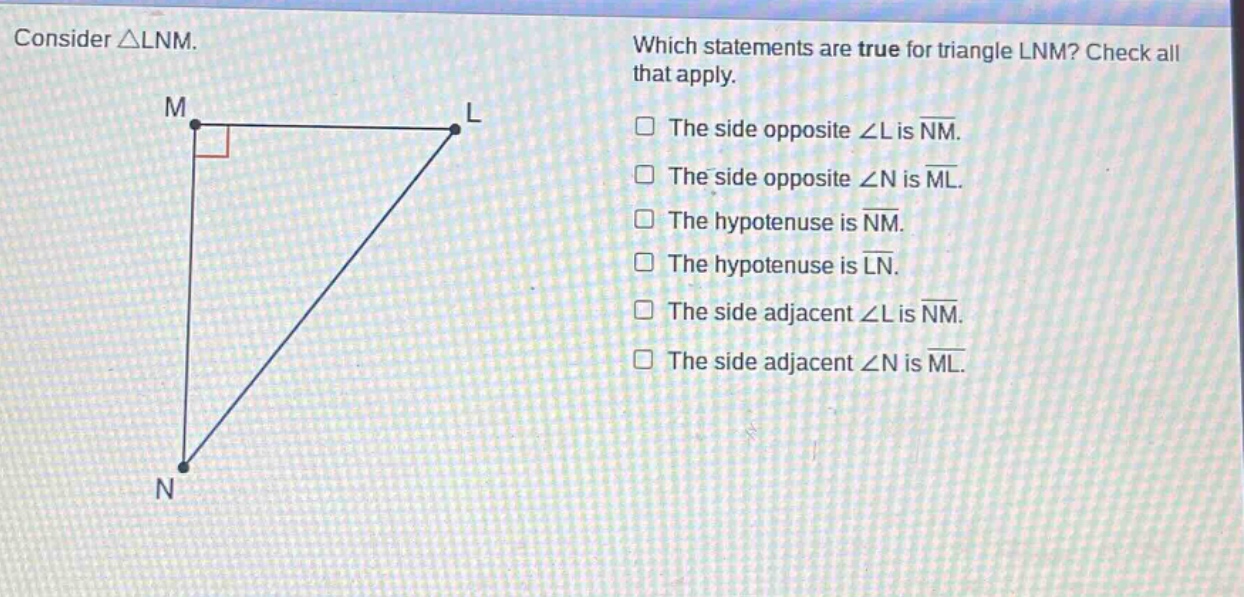
consider △lnm. which statements are true for triangle lnm? check all that apply. the side opposite ∠l is nm. the side opposite ∠n is ml. the hypotenuse is nm. the hypotenuse is ln. the side adjacent ∠l is nm. the side adjacent ∠n is ml.
Answer
Explanation:
Step1: Recall triangle - side angle relationships
In a right - triangle, the side opposite an angle is the non - adjacent side to that angle, and the hypotenuse is the side opposite the right - angle. For (\triangle LNM) with right - angle at (M). The side opposite (\angle L) is the side that does not share the vertex (L) and is not part of the sides forming (\angle L). So, the side opposite (\angle L) is (\overline{NM}). The side opposite (\angle N) is the side that does not share the vertex (N) and is not part of the sides forming (\angle N). So, the side opposite (\angle N) is (\overline{ML}). The hypotenuse is the side opposite the right - angle. Since (\angle M = 90^{\circ}), the hypotenuse is (\overline{LN}). The side adjacent to (\angle L) is (\overline{ML}) (the side that shares the vertex (L) and is not the hypotenuse). The side adjacent to (\angle N) is (\overline{MN}) (the side that shares the vertex (N) and is not the hypotenuse).
Answer:
The side opposite (\angle L) is (\overline{NM}); The side opposite (\angle N) is (\overline{ML}); The hypotenuse is (\overline{LN})