consider u = {x|x is a negative real number}. which is an empty set? {x|x ∈ u and x has a negative cube…
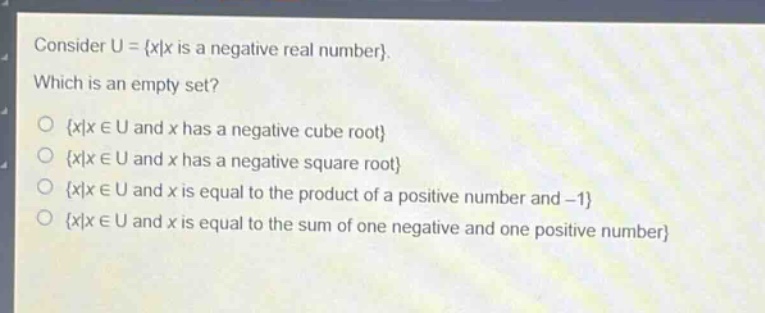
consider u = {x|x is a negative real number}. which is an empty set? {x|x ∈ u and x has a negative cube root} {x|x ∈ u and x has a negative square root} {x|x ∈ u and x is equal to the product of a positive number and -1} {x|x ∈ u and x is equal to the sum of one negative and one positive number}
Answer
Answer:
{x|x ∈ U and x has a negative square root}
Explanation:
Step1: Analyze first option
Negative real - numbers have negative cube roots. For example, if (x=-8), (\sqrt[3]{-8}=-2). So, ({x|x\in U\text{ and }x\text{ has a negative cube root}}) is not an empty set.
Step2: Analyze second option
In the set of real numbers, the square root of a negative number is not a real number. Let (x\in U), i.e., (x < 0). The square root (\sqrt{x}) is not a real - number in the real - number system. So, the set ({x|x\in U\text{ and }x\text{ has a negative square root}}) is an empty set in the set of real numbers.
Step3: Analyze third option
If (x\in U), then (x) can be written as the product of a positive number (y>0) and (- 1), i.e., (x=-y). For example, if (y = 5), (x=-5). So, ({x|x\in U\text{ and }x\text{ is equal to the product of a positive number and }-1}) is not an empty set.
Step4: Analyze fourth option
The sum of a negative number (a<0) and a positive number (b > 0) can be negative. For example, if (a=-3) and (b = 1), then (a + b=-3 + 1=-2\in U). So, ({x|x\in U\text{ and }x\text{ is equal to the sum of one negative and one positive number}}) is not an empty set.