consider points r, s, and t. which statement is true about the geometric figure that can contain these…
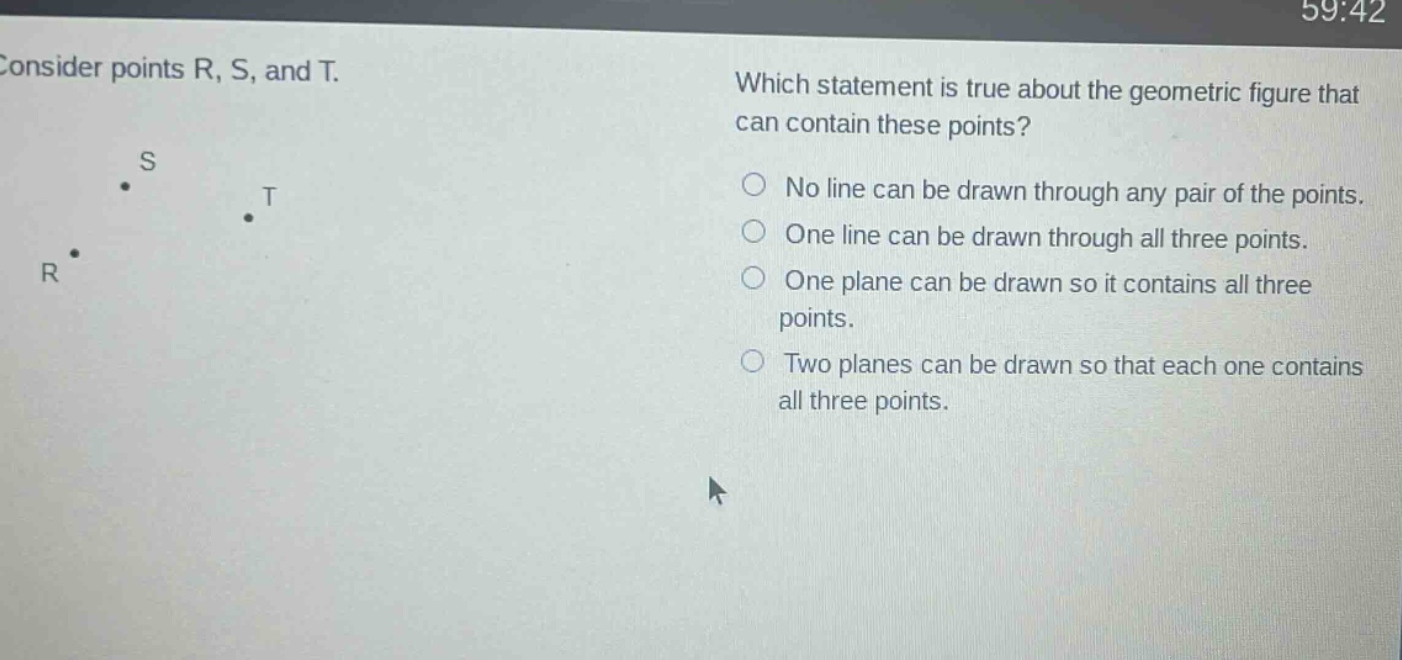
consider points r, s, and t. which statement is true about the geometric figure that can contain these points? no line can be drawn through any pair of the points. one line can be drawn through all three points. one plane can be drawn so it contains all three points. two planes can be drawn so that each one contains all three points.
Answer
Explanation:
Step1: Recall geometric postulates
Through any two - points, a line can be drawn. So the first option is false.
Step2: Analyze collinearity
Three non - collinear points do not lie on the same line. Since no information about collinearity is given, we cannot assume they are collinear. So the second option is not necessarily true.
Step3: Apply plane - point postulate
Through any three non - collinear points, exactly one plane can be drawn. If the points are collinear, they still lie on a plane (infinitely many planes can contain a line, but there is at least one). So one plane can be drawn to contain all three points.
Step4: Understand uniqueness of plane for three points
There is not a case where two distinct planes can contain the same three non - collinear points. And for collinear points, there are infinitely many planes but not exactly two. So the fourth option is false.
Answer:
One plane can be drawn so it contains all three points.