consider the statement: \the sum of a rational number and an irrational number is always rational.\ choose…
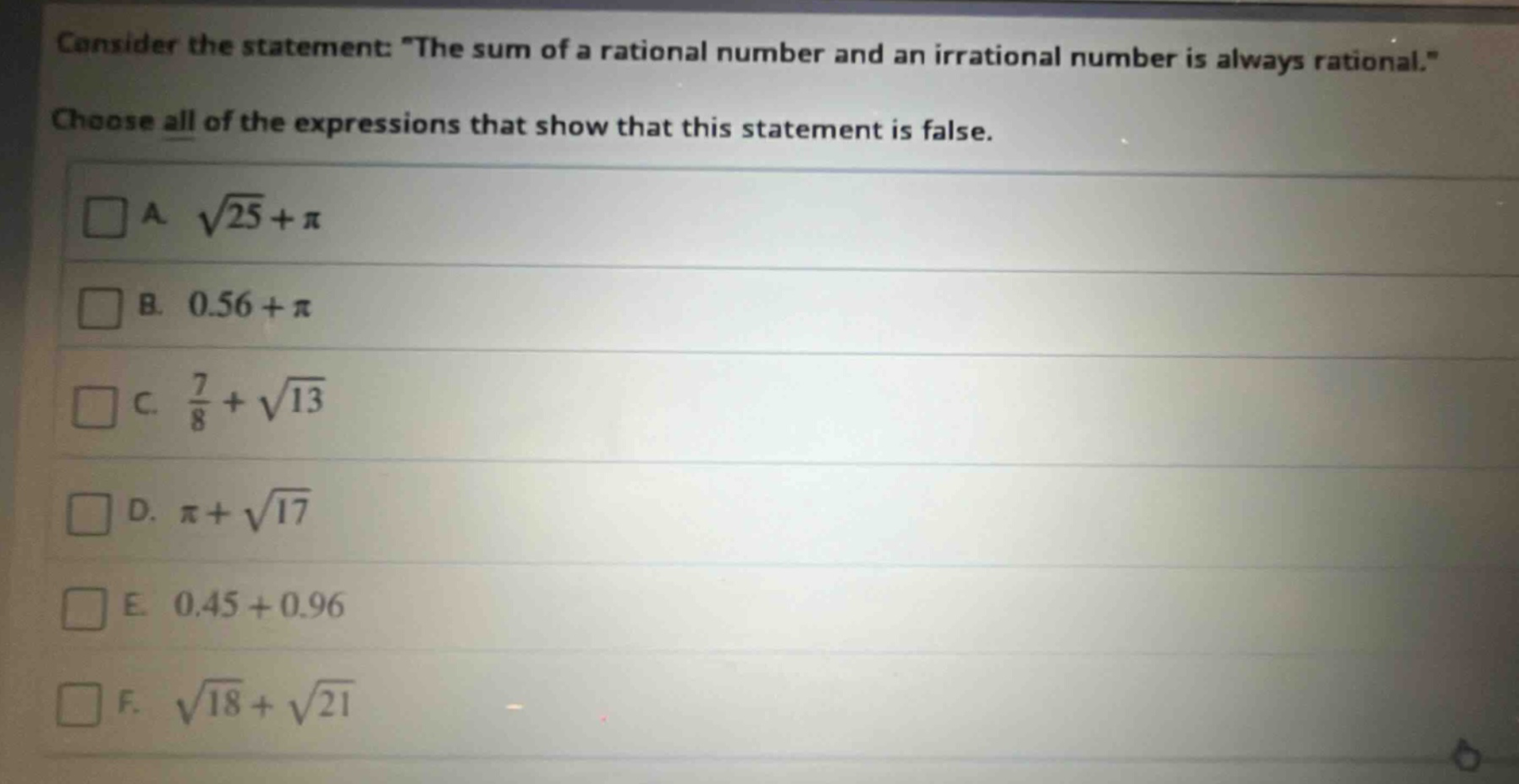
consider the statement: \the sum of a rational number and an irrational number is always rational.\ choose all of the expressions that show that this statement is false. a. $sqrt{25}+pi$ b. $0.56+pi$ c. $\frac{7}{8}+sqrt{13}$ d. $pi+sqrt{17}$ e. $0.45 + 0.96$ f. $sqrt{18}+sqrt{21}$
Answer
Explanation:
Step1: Recall rational and irrational numbers
A rational number can be written as a fraction $\frac{a}{b}$ where $a,b\in\mathbb{Z}$ and $b\neq0$. Irrational numbers cannot be written as such. $\sqrt{25}=5$ is rational, $\pi,\sqrt{13},\sqrt{17},\sqrt{18},\sqrt{21}$ are irrational.
Step2: Analyze option A
$\sqrt{25}+\pi = 5+\pi$. Here 5 is rational and $\pi$ is irrational. Their sum is irrational.
Step3: Analyze option B
$0.56+\pi$. Since $0.56=\frac{56}{100}$ is rational and $\pi$ is irrational, their sum is irrational.
Step4: Analyze option C
$\frac{7}{8}+\sqrt{13}$. $\frac{7}{8}$ is rational and $\sqrt{13}$ is irrational, so their sum is irrational.
Step5: Analyze option D
$\pi+\sqrt{17}$ is a sum of two irrational numbers, but we need sum of rational - irrational.
Step6: Analyze option E
$0.45 + 0.96=1.41=\frac{141}{100}$ is a sum of two rational numbers.
Step7: Analyze option F
$\sqrt{18}+\sqrt{21}$ is a sum of two irrational numbers, not a sum of rational - irrational.
Answer:
A. $\sqrt{25}+\pi$, B. $0.56+\pi$, C. $\frac{7}{8}+\sqrt{13}$