the contrapositive of a conditional statement is \if an item is not worth five dimes, then it is not worth…
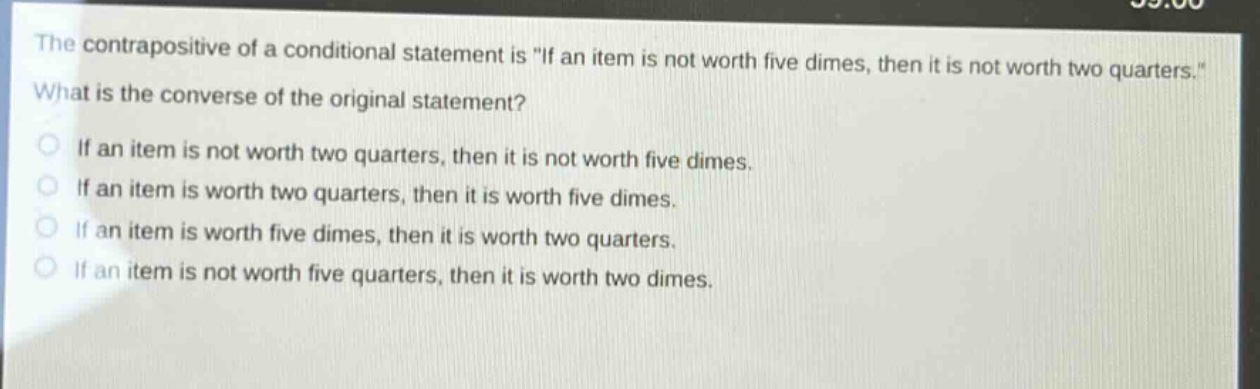
the contrapositive of a conditional statement is \if an item is not worth five dimes, then it is not worth two quarters.\ what is the converse of the original statement? if an item is not worth two quarters, then it is not worth five dimes. if an item is worth two quarters, then it is worth five dimes. if an item is worth five dimes, then it is worth two quarters. if an item is not worth five quarters, then it is worth two dimes.
Answer
Brief Explanations:
- Recall the relationship between conditional statements, contra - positives, and converses. A conditional statement is of the form "if p then q", its contra - positive is "if not q then not p", and its converse is "if q then p".
- Given the contra - positive "If an item is not worth five dimes, then it is not worth two quarters", the original conditional statement is "If an item is worth two quarters, then it is worth five dimes" (since the original conditional and the contra - positive are logically equivalent).
- The converse of the original conditional statement "If an item is worth two quarters, then it is worth five dimes" is found by swapping the hypothesis and the conclusion. So the converse is "If an item is worth five dimes, then it is worth two quarters".
Answer:
If an item is worth five dimes, then it is worth two quarters.