convert the equation you found, $t = a^{3/2}$, into a form without any rational exponents.\n$t^{3}=a^{2}$\n$\…
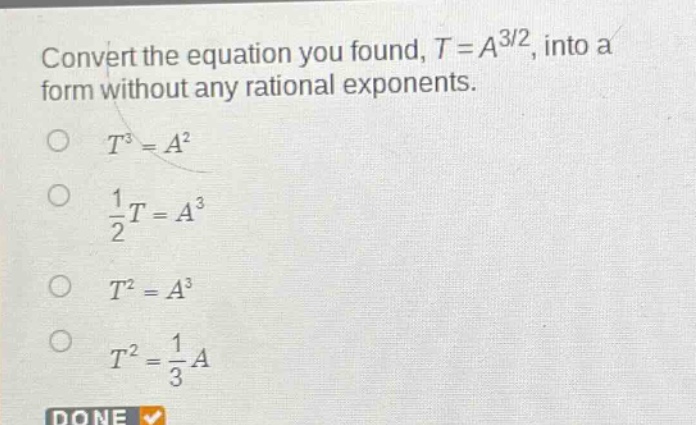
convert the equation you found, $t = a^{3/2}$, into a form without any rational exponents.\n$t^{3}=a^{2}$\n$\frac{1}{2}t = a^{3}$\n$t^{2}=a^{3}$\n$t^{2}=\frac{1}{3}a$\ndone
Answer
Explanation:
Step1: Square both sides
Square both sides of the equation $T = A^{3/2}$ to get rid of the rational exponent. According to the power - of - a - power rule $(a^m)^n=a^{mn}$. So, $(T)^2=(A^{3/2})^2$. $T^2 = A^{\frac{3}{2}\times2}$
Step2: Simplify the exponent
Calculate the exponent on the right - hand side. $\frac{3}{2}\times2 = 3$. So, $T^2=A^3$.
Answer:
$T^2 = A^3$ (corresponding to the third option)