on each coordinate plane, the parent function f(x) = |x| is represented by a dashed line and a translation…
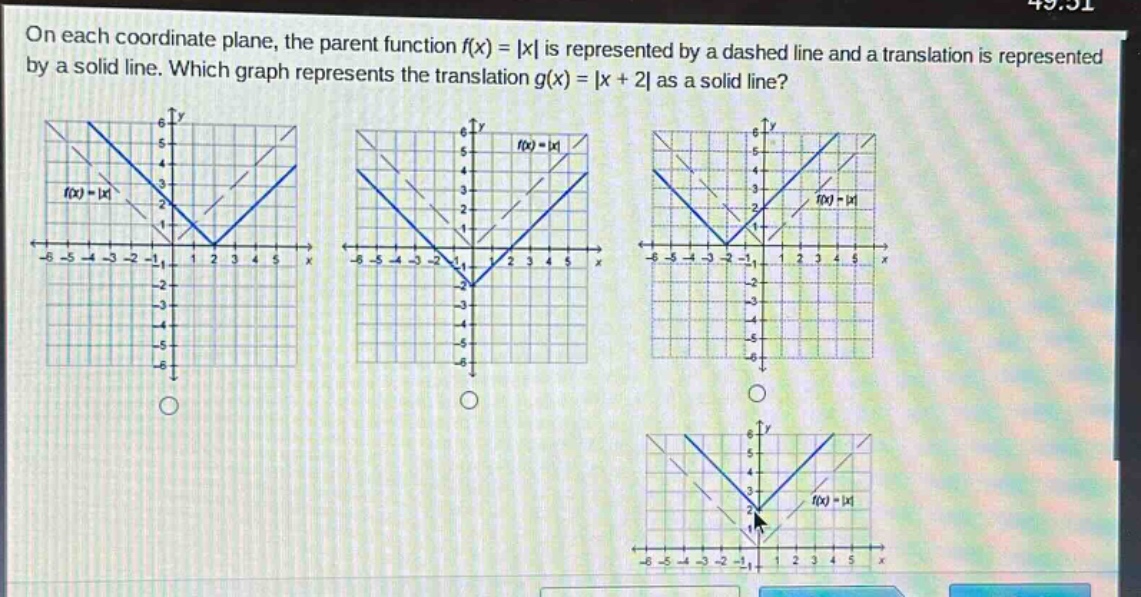
on each coordinate plane, the parent function f(x) = |x| is represented by a dashed line and a translation is represented by a solid line. which graph represents the translation g(x) = |x + 2| as a solid line?
Answer
Explanation:
Step1: Recall transformation rule
For the absolute - value function $y = f(x - h)$, a positive $h$ shifts the graph of $y = f(x)$ to the right by $h$ units and a negative $h$ shifts it to the left by $|h|$ units. Given $g(x)=|x + 2|=|x-(-2)|$, the graph of the parent function $f(x)=|x|$ is shifted 2 units to the left.
Step2: Analyze key - points
The vertex of the parent function $f(x)=|x|$ is at the origin $(0,0)$. For the function $g(x)=|x + 2|$, when $x=-2$, $g(-2)=| - 2+2| = 0$. So the vertex of $g(x)$ is at the point $(-2,0)$.
Answer:
The graph where the dashed line (representing $f(x)=|x|$) has a vertex at $(0,0)$ and the solid line (representing $g(x)=|x + 2|$) has a vertex at $(-2,0)$ is the correct one. Without seeing the specific options clearly, the key is to look for the graph where the solid - line $V$ - shaped graph (of $g(x)$) is 2 units to the left of the dashed - line $V$ - shaped graph (of $f(x)$).