o y = cos(\\frac{x}{0.4})\no y = cos(5x)\no y = cos(0.4x)\no y = cos(\\frac{x}{5})
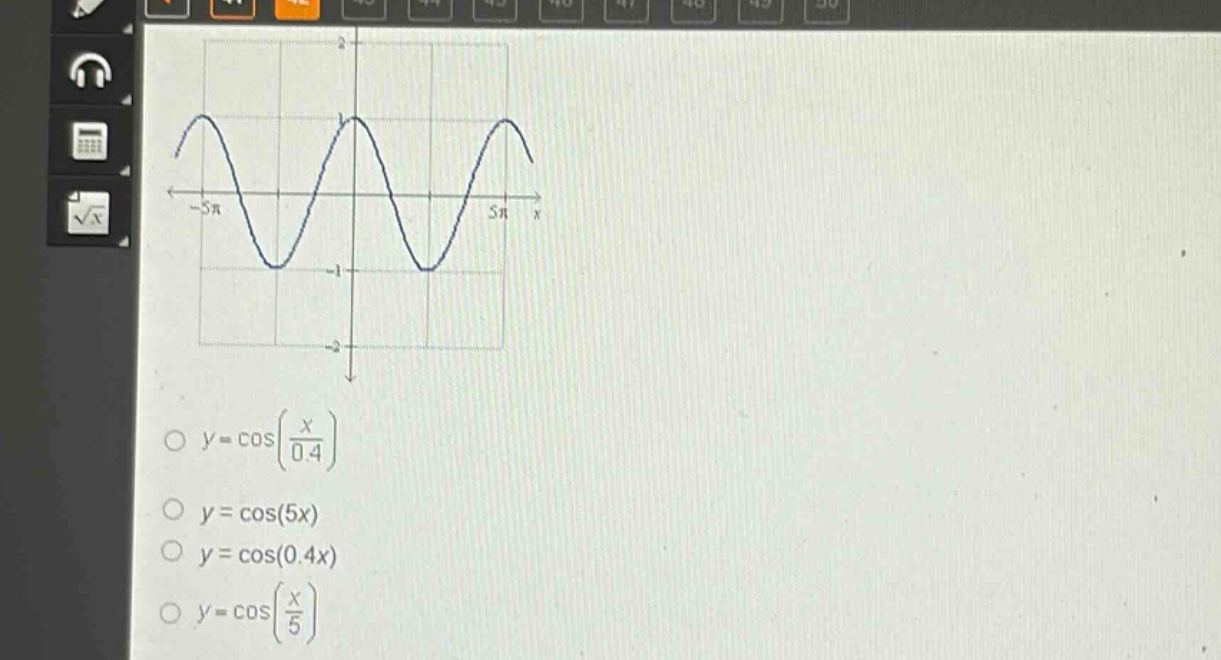
o y = cos(\\frac{x}{0.4})\no y = cos(5x)\no y = cos(0.4x)\no y = cos(\\frac{x}{5})
Answer
Explanation:
Step1: Recall the period - formula for cosine function
The general form of a cosine function is $y = A\cos(Bx - C)+D$, and its period is $T=\frac{2\pi}{|B|}$.
Step2: Determine the period from the graph
From the graph, we can see that the period $T$ of the cosine - wave is $T = \frac{2\pi}{5}\times2=\frac{4\pi}{5}$.
Step3: Find the value of $B$
We know that $T=\frac{2\pi}{|B|}$. Substituting $T = \frac{4\pi}{5}$ into the formula, we get $\frac{4\pi}{5}=\frac{2\pi}{|B|}$. Cross - multiply: $4\pi|B| = 10\pi$. Then $|B| = 2.5$. But if we assume the standard form without phase - shift and vertical - shift, and consider the form $y=\cos(Bx)$, when we analyze the options: For $y = \cos(0.4x)$, $B = 0.4=\frac{2}{5}$, and $T=\frac{2\pi}{0.4}=5\pi$. For $y=\cos(5x)$, $B = 5$, and $T=\frac{2\pi}{5}$. For $y=\cos(\frac{x}{0.4})=\cos(2.5x)$, $B = 2.5$, and $T=\frac{2\pi}{2.5}=\frac{4\pi}{5}$. For $y=\cos(\frac{x}{5})$, $B=\frac{1}{5}$, and $T = 10\pi$.
Answer:
$y=\cos(\frac{x}{0.4})$