which cube root function is always decreasing as x increases?\n○ (f(x)=sqrt3{x - 8})\n○ (f(x)=sqrt3{x}-5)\n○…
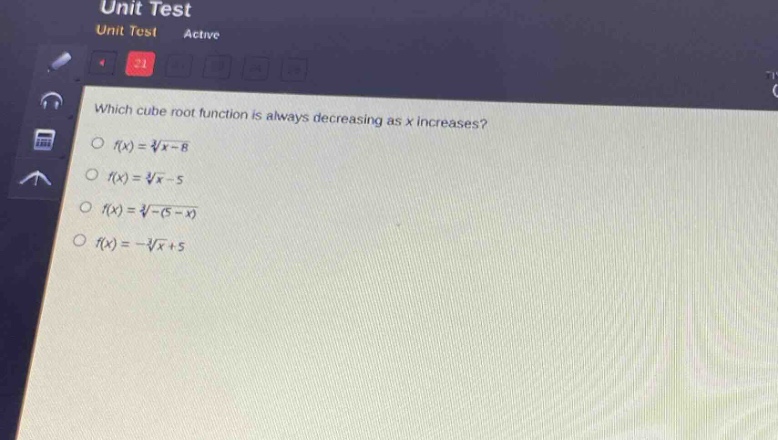
which cube root function is always decreasing as x increases?\n○ (f(x)=sqrt3{x - 8})\n○ (f(x)=sqrt3{x}-5)\n○ (f(x)=sqrt3{-(5 - x)})\n○ (f(x)=-sqrt3{x}+5)
Answer
Explanation:
Step1: Recall cube - root function property
The basic cube - root function is $y = \sqrt[3]{x}$, which is an increasing function. For a cube - root function of the form $y=a\sqrt[3]{x - h}+k$, the sign of $a$ determines the increasing or decreasing behavior. If $a>0$, the function is increasing, and if $a < 0$, the function is decreasing.
Step2: Analyze each option
- Option 1: $f(x)=\sqrt[3]{x - 8}$, here $a = 1>0$, so it is an increasing function.
- Option 2: $f(x)=\sqrt[3]{x}-5$, here $a = 1>0$, so it is an increasing function.
- Option 3: $f(x)=\sqrt[3]{-(5 - x)}=\sqrt[3]{x - 5}$, here $a = 1>0$, so it is an increasing function.
- Option 4: $f(x)=-\sqrt[3]{x}+5$, here $a=- 1<0$, so as $x$ increases, $y$ decreases.
Answer:
$f(x)=-\sqrt[3]{x}+5$