the curve through the ordered pairs (0, 10), (1, 5), and (2, 2.5) can be represented by the function…
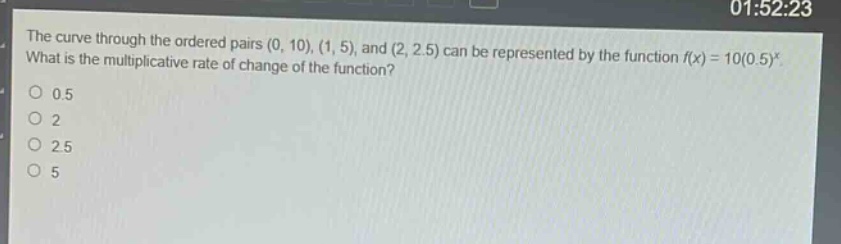
the curve through the ordered pairs (0, 10), (1, 5), and (2, 2.5) can be represented by the function (f(x)=10(0.5)^x). what is the multiplicative rate of change of the function?\n0.5\n2\n2.5\n5
Answer
Answer:
A. 0.5
Explanation:
Step1: Recall exponential - function form
The general form of an exponential function is $y = a\cdot b^{x}$, where $b$ is the multiplicative rate of change.
Step2: Identify the function
The given function is $f(x)=10(0.5)^{x}$.
Step3: Determine the multiplicative rate of change
In the function $f(x)=10(0.5)^{x}$, comparing with $y = a\cdot b^{x}$, we have $b = 0.5$. So the multiplicative rate of change of the function is 0.5.