the curve through the ordered pairs (0, 10), (1, 5), and (2, 2.5) can be represented by the function f(x) =…
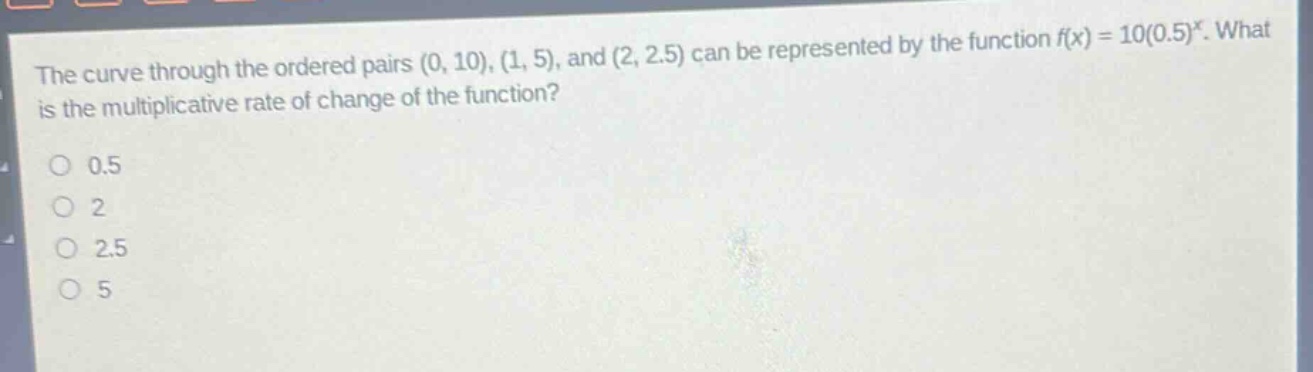
the curve through the ordered pairs (0, 10), (1, 5), and (2, 2.5) can be represented by the function f(x) = 10(0.5)^x. what is the multiplicative rate of change of the function?\n0.5\n2\n2.5\n5
Answer
Explanation:
Step1: Identify the exponential - function form
The general form of an exponential function is $y = a(b)^x$, where $b$ is the multiplicative rate of change.
Step2: Compare with the given function
The given function is $f(x)=10(0.5)^x$. Here, $a = 10$ and $b = 0.5$. The multiplicative rate of change of an exponential function $y=a(b)^x$ is $b$.
Answer:
A. 0.5