dana wants to make two types of dog treats. she has 10 cups of peanut butter and 12 cups of flour. her dog…
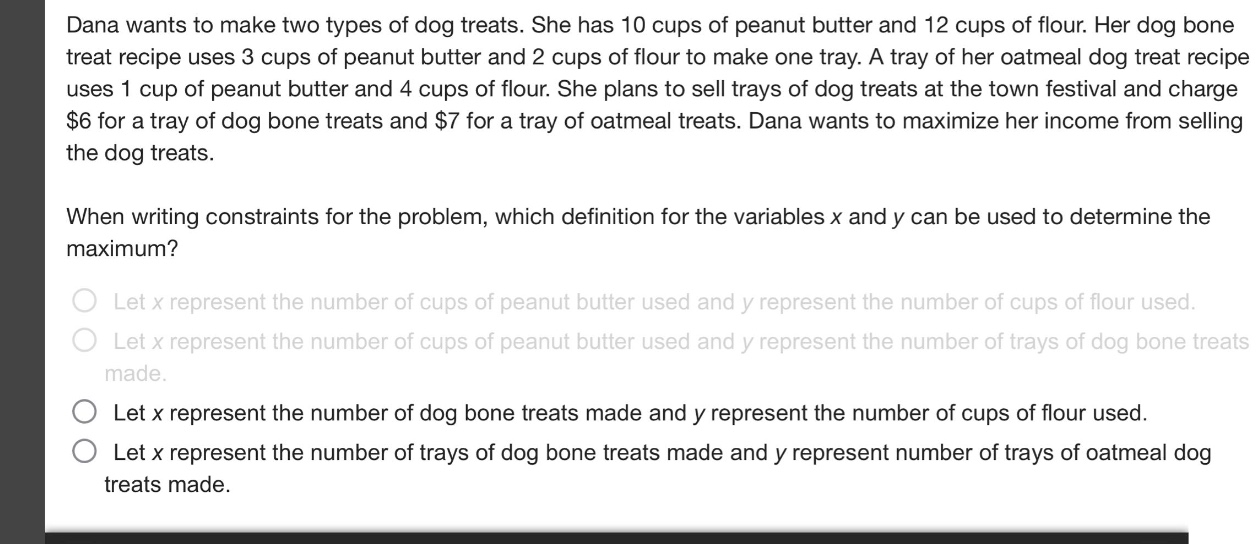
dana wants to make two types of dog treats. she has 10 cups of peanut butter and 12 cups of flour. her dog bone treat recipe uses 3 cups of peanut butter and 2 cups of flour to make one tray. a tray of her oatmeal dog treat recipe uses 1 cup of peanut butter and 4 cups of flour. she plans to sell trays of dog treats at the town festival and charge $6 for a tray of dog bone treats and $7 for a tray of oatmeal treats. dana wants to maximize her income from selling the dog treats. when writing constraints for the problem, which definition for the variables x and y can be used to determine the maximum? let x represent the number of cups of peanut butter used and y represent the number of cups of flour used. let x represent the number of cups of peanut butter used and y represent the number of trays of dog bone treats made. let x represent the number of dog bone treats made and y represent the number of cups of flour used. let x represent the number of trays of dog bone treats made and y represent number of trays of oatmeal dog treats made.
Answer
Brief Explanations:
To maximize income from selling two types of dog - treats, we need to define variables based on the number of each type of treat made. Since we want to find the number of trays of each type of dog - treat to make for maximum income, we should let (x) be the number of trays of one type (dog bone treats) and (y) be the number of trays of the other type (oatmeal dog treats). This way, we can write constraints based on the available ingredients and an objective function for income.
Answer:
Let (x) represent the number of trays of dog bone treats made and (y) represent number of trays of oatmeal dog treats made.