determine which equations have the same solution set as $\frac{2}{3}-x+\frac{1}{6}=6x$ by recognizing…
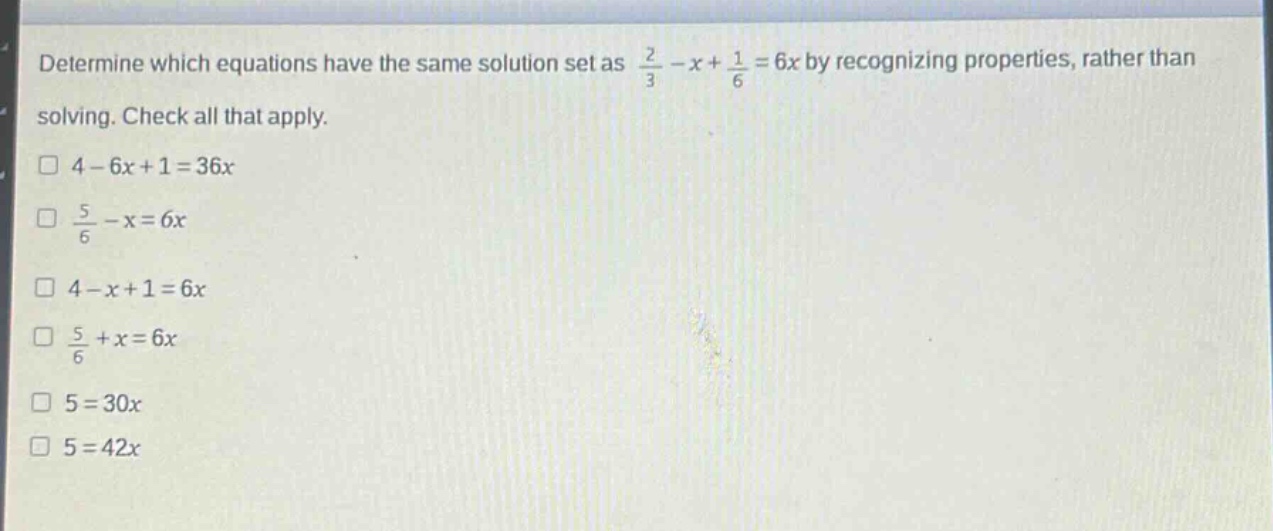
determine which equations have the same solution set as $\frac{2}{3}-x+\frac{1}{6}=6x$ by recognizing properties, rather than solving. check all that apply.\n$4 - 6x+1 = 36x$\n$\frac{5}{6}-x = 6x$\n$4 - x+1 = 6x$\n$\frac{5}{6}+x = 6x$\n$5 = 30x$\n$5 = 42x$
Answer
Explanation:
Step1: Simplify the original equation
First, find a common - denominator for the left - hand side of $\frac{2}{3}-x+\frac{1}{6}=6x$. The common denominator of 3 and 6 is 6. So, $\frac{2\times2}{3\times2}-x+\frac{1}{6}=6x$, which simplifies to $\frac{4}{6}-x+\frac{1}{6}=6x$. Then, $\frac{4 + 1}{6}-x=6x$, and further simplifies to $\frac{5}{6}-x=6x$.
Step2: Analyze each option
Option 1: $4−6x + 1=36x$
Starting from the original equation $\frac{2}{3}-x+\frac{1}{6}=6x$, multiply each term by 18 (the least common multiple of 3 and 6). We get $18\times\frac{2}{3}-18x+18\times\frac{1}{6}=18\times6x$, which is $12-18x + 3=108x$, or $15-18x=108x$. This is not equivalent.
Option 2: $\frac{5}{6}-x=6x$
This is the simplified form of the original equation, so it has the same solution set.
Option 3: $4−x + 1=6x$
This is not equivalent to the original equation. The original equation when simplified does not match this form.
Option 4: $\frac{5}{6}+x=6x$
The sign of $x$ on the left - hand side is different from the simplified original equation, so it is not equivalent.
Option 5: $5 = 30x$
Starting from $\frac{5}{6}-x=6x$, add $x$ to both sides to get $\frac{5}{6}=7x$. Then multiply both sides by 6 to get $5 = 42x$, not $5 = 30x$. So it is not equivalent.
Option 6: $5 = 42x$
Starting from $\frac{5}{6}-x=6x$, add $x$ to both sides: $\frac{5}{6}=7x$. Multiply both sides by 6 gives $5 = 42x$, which is equivalent.
Answer:
$\frac{5}{6}-x=6x$, $5 = 42x$