determine the number of x - intercepts that appear on a graph of each function.\n$f(x)=(x + 1)(x - 3)(x…
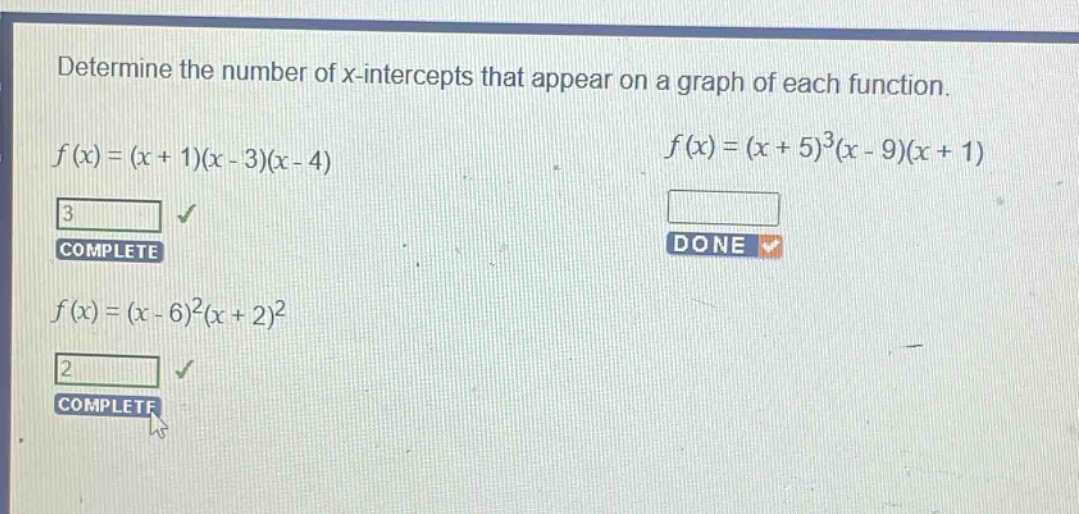
determine the number of x - intercepts that appear on a graph of each function.\n$f(x)=(x + 1)(x - 3)(x - 4)$\n$f(x)=(x + 5)^3(x - 9)(x + 1)$\n$f(x)=(x - 6)^2(x + 2)^2$
Answer
Explanation:
Step1: Recall x - intercept concept
The x - intercepts of a function (y = f(x)) are found by setting (f(x)=0).
Step2: Solve (f(x)=(x + 5)^3(x - 9)(x + 1)=0)
Using the zero - product property, if (ab = 0), then (a = 0) or (b = 0). Here, ((x + 5)^3(x - 9)(x + 1)=0) when (x+5 = 0) or (x - 9=0) or (x + 1=0).
Step3: Find the roots
For (x+5 = 0), (x=-5); for (x - 9=0), (x = 9); for (x + 1=0), (x=-1). The factor ((x + 5)) has a multiplicity of 3, but it still corresponds to one x - intercept at (x=-5).
Answer:
3