determining two - variable linear inequalities with no solution\nwhich linear inequality will not have a…
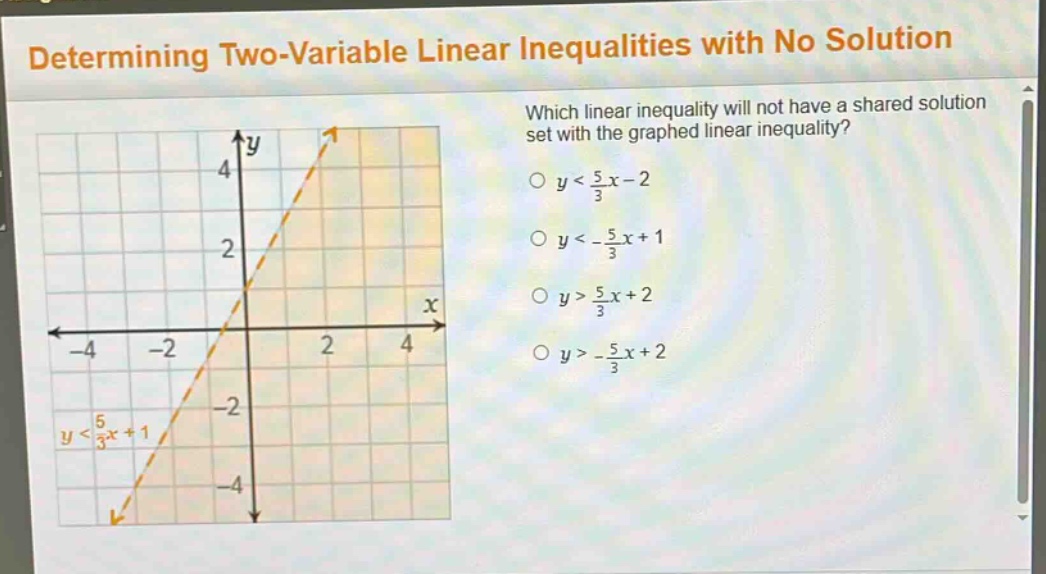
determining two - variable linear inequalities with no solution\nwhich linear inequality will not have a shared solution set with the graphed linear inequality?\n$y<\\frac{5}{3}x - 2$\n$y< - \\frac{5}{3}x + 1$\n$y>\\frac{5}{3}x + 2$\n$y> - \\frac{5}{3}x + 2$\n$y<\\frac{5}{3}x + 1$
Answer
Explanation:
Step1: Analyze the given inequality
The given inequality is $y<\frac{5}{3}x + 1$. Its slope is $\frac{5}{3}$ and y - intercept is 1.
Step2: Consider parallel lines
Two - variable linear inequalities with no shared solution set are parallel and non - overlapping. Parallel lines have the same slope.
Step3: Check each option
For $y<\frac{5}{3}x - 2$, slope is $\frac{5}{3}$, but it can overlap with $y<\frac{5}{3}x + 1$. For $y<-\frac{5}{3}x + 1$, slope is different, so it can intersect. For $y>\frac{5}{3}x + 2$, slope is $\frac{5}{3}$ and it is above the line $y=\frac{5}{3}x + 1$. Since $y<\frac{5}{3}x + 1$ and $y>\frac{5}{3}x + 2$, there is no shared solution set. For $y>-\frac{5}{3}x + 2$, slope is different, so it can intersect.
Answer:
$y>\frac{5}{3}x + 2$