in the diagram, g // h, m∠1=(4x + 36)°, and m∠2=(3x - 3)°. what is the measure of ∠3? 21° 60° 120° 159°
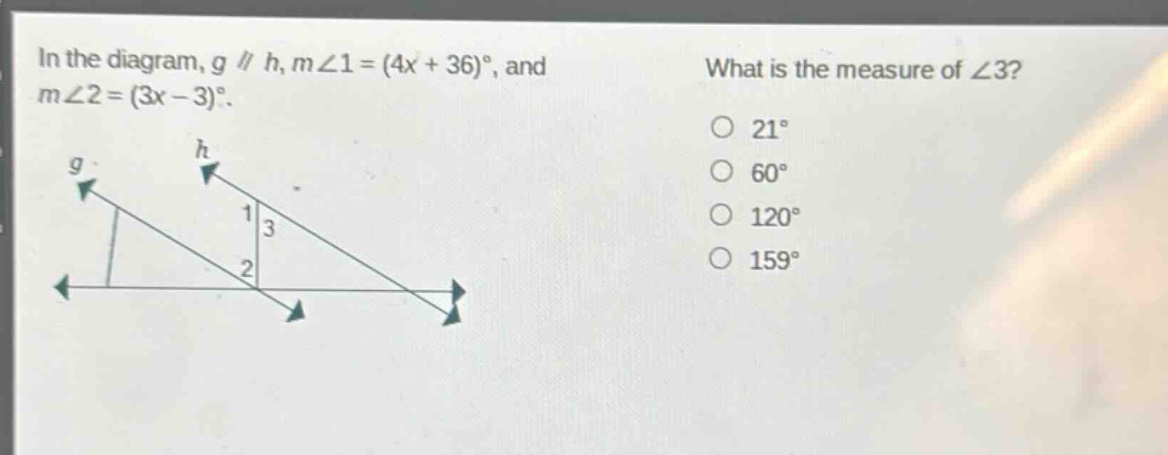
in the diagram, g // h, m∠1=(4x + 36)°, and m∠2=(3x - 3)°. what is the measure of ∠3? 21° 60° 120° 159°
Answer
Explanation:
Step1: Use the property of corresponding angles
Since (g\parallel h), (\angle1) and (\angle2) are corresponding angles, so (m\angle1 = m\angle2). Then we set up the equation (4x + 36=3x - 3).
Step2: Solve the equation for (x)
Subtract (3x) from both sides: (4x-3x + 36=3x-3x - 3), which gives (x+36=-3). Then subtract 36 from both sides: (x=-3 - 36=-39).
Step3: Find the measure of (\angle1)
Substitute (x = - 39) into the expression for (m\angle1): (m\angle1=4x + 36=4\times(-39)+36=-156 + 36=-120) (This is wrong. We should note that (\angle1) and (\angle2) are same - side interior angles, so (m\angle1+m\angle2 = 180^{\circ})).
Step4: Correctly set up the equation
Set up the equation (4x + 36+3x - 3=180). Combine like - terms: (7x+33 = 180).
Step5: Solve the new equation for (x)
Subtract 33 from both sides: (7x=180 - 33=147). Divide both sides by 7: (x = 21).
Step6: Find the measure of (\angle1)
Substitute (x = 21) into the expression for (m\angle1): (m\angle1=4x + 36=4\times21+36=84 + 36=120^{\circ}).
Step7: Use the property of vertical angles
Since (\angle1) and (\angle3) are vertical angles, (m\angle3=m\angle1). So (m\angle3 = 120^{\circ}).
Answer:
(120^{\circ})